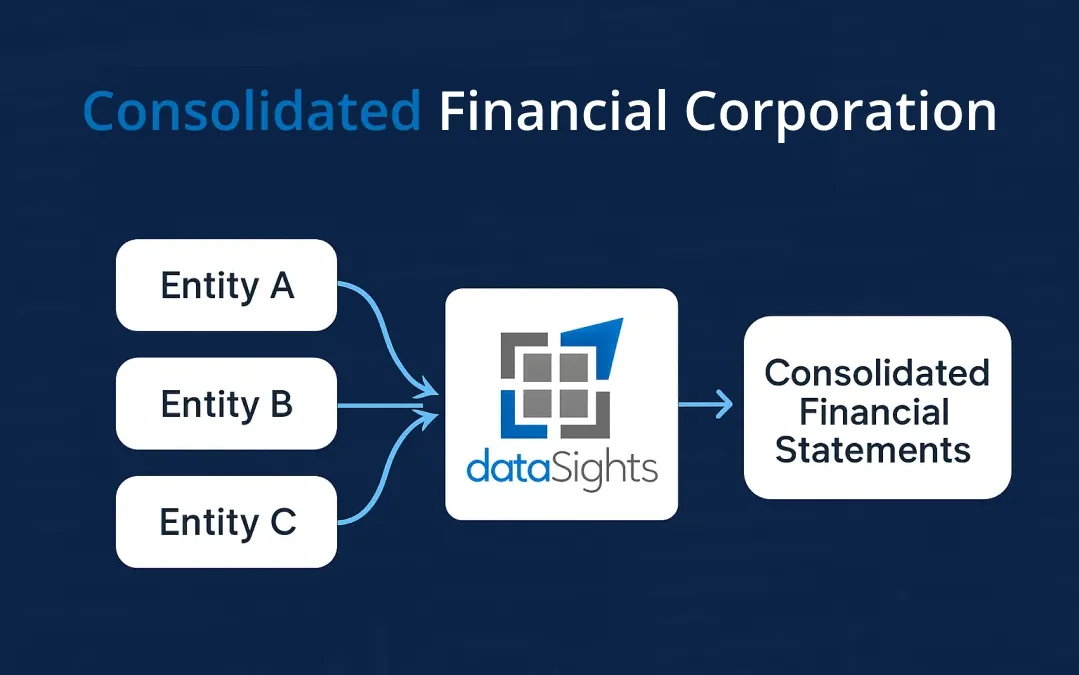
If you manage multiple entities, consolidation usually fails in the same places every month: mismatched intercompany balances, FX translation, and eliminations living in fragile spreadsheets. A consolidated financial corporation is simply a group that reports parent and subsidiaries as one economic entity, so you can’t treat month-end like “add the columns and hope”. IFRS and US GAAP (ASC 810) both require consolidation when control exists, but the operational work is what consumes your team’s time. This guide explains what the term means in practice and how automation reduces manual consolidation work without losing auditability.
A consolidated financial corporation is a corporate group where a parent company controls one or more subsidiaries and must present their combined financial results in a single set of statements. Under IFRS 10, control requires three elements: power over the investee, exposure to variable returns, and the ability to affect those returns. In the UK, section 399 of the Companies Act 2006 requires parent company directors to prepare group accounts unless a specific exemption applies, such as small group thresholds where the aggregate balance sheet total is no more than £7.5 million net for accounting periods that begin on or after 6 April 2025.
A consolidated financial corporation is not a legal label – it is a reporting responsibility for groups that control multiple entities. The goal is to produce one set of results that reflects the group as a single economic unit, supported by reconcilable Trial Balances, consistent policies, and defensible eliminations. Most month-end stress comes from manual workarounds, version confusion, and intercompany mismatches rather than the standards themselves. When consolidation is structured and automated, teams spend less time rebuilding numbers and more time explaining performance with confidence. Done well, group reporting should reduce complexity and improve decision-making.
What Is a Consolidated Financial Corporation?
The phrase “consolidated financial corporation” isn’t a legal category. It’s shorthand for group consolidation: preparing consolidated financial statements by combining the parent and subsidiaries and removing intra-group activity. Instead, it describes any corporate group that prepares consolidated financial statements – combining data from a parent company and its subsidiaries into one unified report.
A parent company owns and controls another company, called a subsidiary. Ownership of more than 50% often indicates control, but consolidation is required based on control:
- Power over relevant activities
- Exposure to variable returns
- Ability to use that power to affect returns
Under US GAAP, consolidation is generally required when an entity has a controlling financial interest under ASC 810. The resulting consolidated financial statements present the group’s assets, liabilities, equity, income, expenses, and cash flows as if all entities were a single economic unit.
This means intercompany transactions get eliminated. If Subsidiary A sells goods to Subsidiary B within the same corporate group, that sale disappears from the consolidated results. Only transactions with external third parties remain. This prevents double-counting of revenue, expenses, and balances within the group.
Why the Term Matters for Your Business
You may encounter “consolidated financial corporation” when researching corporate structures, filing requirements, or setting up multi-entity reporting. Whether your group has 3 entities or 40, the same principles apply: if you control subsidiaries, you need consolidated financial statements.
When Is Consolidated Financial Reporting Required?
Not every corporate group must prepare consolidated statements. The requirements depend on your jurisdiction and the size of your group.
- Under IFRS: IFRS 10 requires any parent entity that controls one or more subsidiaries to present consolidated financial statements. Exemptions exist for wholly-owned or partially-owned subsidiaries of another parent, provided the ultimate parent already prepares IFRS-compliant consolidated statements available for public use.
- Under UK law: The Companies Act 2006 requires parent company directors to prepare group accounts. However, an exemption may apply where the group qualifies as a “small group” under the Act’s size criteria. These tests generally consider turnover, balance sheet total, and employee numbers, and updated thresholds apply to accounting periods beginning on or after 6 April 2025. Always check current GOV.UK guidance before relying on specific figures.
- Under US GAAP: FASB guidelines require consolidated financial statements when a company has a controlling financial interest in another entity. This is usually indicated by owning more than 50% of voting shares, but under ASC 810, control can still exist below that level – or may not exist even above it – depending on shareholder rights and contractual arrangements.
The common thread across all frameworks is control. If your corporation controls another entity – whether through majority voting rights, contractual arrangements, or board composition – consolidation is almost certainly required.
The Corporate Financial Consolidation Process
Preparing consolidated financial statements for a corporate group involves more than adding numbers together. The financial consolidation process follows a structured workflow.
Step 1: Collect and Validate Entity Trial Balances
Every consolidation starts with the Trial Balance for each entity – not summary P&L totals or exported reports. Before combining anything, confirm each entity’s Trial Balance is complete, balances (debits = credits), and is locked for the reporting period. Map accounts to a common group chart of accounts and confirm consistent accounting policies across entities. If your group numbers cannot trace back to each entity’s Trial Balance, you are not consolidating – you are rebuilding accounts in a spreadsheet.
Step 2: Standardise Group Structure and Reporting Rules
Define the group structure (parent, subsidiaries, ownership %, reporting currency, and reporting periods) so the consolidation logic stays consistent month to month. Set reporting rules upfront: which entities consolidate, how you treat acquisitions/disposals, materiality thresholds for reclassifications, and which accounts are in scope for eliminations. This is also where you standardise entity naming, cost centres, and tracking categories, so reporting is comparable. A clear structure prevents downstream rework and reduces “why doesn’t Entity B match last month?” debates.
Step 3: Translate Foreign Currency Where Needed (IAS 21)
If the group has entities in different currencies, translate results using a consistent approach aligned to IAS 21. Income and expenses are typically translated using average rates, assets and liabilities at the closing rate, equity at historical rates, and translation differences flow through OCI into the translation reserve until disposal. Also, be explicit about functional currency vs presentation currency, because that drives the translation method and audit expectations. FX is easy to apply mechanically, but hard to defend if the policy is unclear.
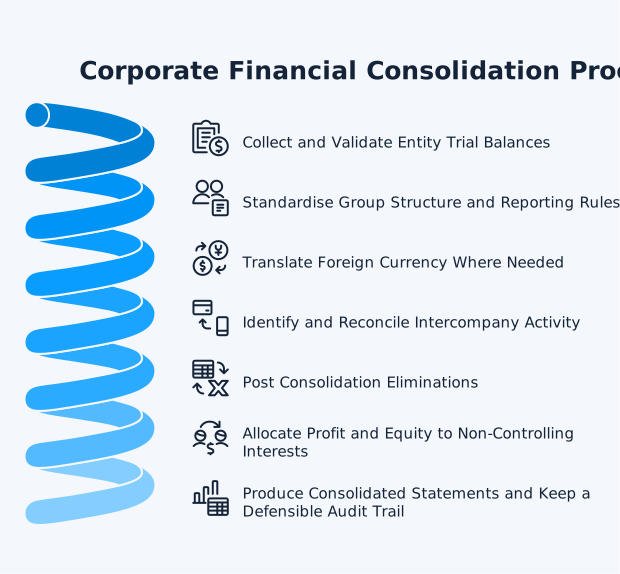
Step 4: Identify and Reconcile Intercompany Activity Before Eliminations
Before you post eliminations, you must first identify and reconcile all intercompany balances and transactions. Eliminations only work if both sides of the relationship agree. If Entity A shows a £120,000 receivable and Entity B shows a £105,000 payable, the issue is not elimination – it is reconciliation.
Start by listing all intercompany relationships across the group:
- Intercompany loans
- Intercompany trade receivables and payables
- Intra-group sales and cost allocations
- Management fees and shared service charges
- Intercompany dividends
- Intercompany asset transfers
Then reconcile differences before posting any consolidation journals. Most mismatches are caused by:
- Timing differences (cut-off issues)
- FX differences between booking dates
- Different account classifications
- Missing or misposted invoices
- Unmatched counterparty coding
Why This Step Causes Most Delays
Intercompany mismatches are one of the biggest drivers of month-end overruns in multi-entity groups. When reconciliations happen late, eliminations become guesswork and audit queries increase. A structured approach – counterparty tagging, standard intercompany accounts, and a reconciliation log – reduces both close time and review friction.
Automation Perspective
Automation is particularly effective here. If intercompany accounts are consistently tagged and mapped at entity level, balances can be matched automatically and flagged when differences exceed tolerance. This shifts the team’s time from hunting errors to resolving genuine issues.
Step 5: Post Consolidation Eliminations (Core Step)
Eliminations remove intra-group activity, so the consolidated results show only external performance. This includes intercompany revenue/expenses, intercompany balances, intercompany dividends, and (where applicable) unrealised profit on intra-group inventory or asset transfers. The goal is not only to post entries, but to keep an audit trail: what was eliminated, why, and how it ties back to source Trial Balances. This is the step most likely to trigger audit questions, so it must be documented and repeatable – not “last month’s spreadsheet plus tweaks.”
Example:
Entity A sells inventory to Entity B for £50,000 (cost £40,000). If Entity B still holds it at period-end, eliminate the £10,000 unrealised profit so group inventory remains at cost to the group.
Step 6: Allocate Profit and Equity to Non-Controlling Interests (NCI)
If the parent owns less than 100% of a subsidiary, you must present NCI in equity and allocate profit between owners of the parent and NCI. This is not optional and should be applied after eliminations, so the profit split is based on the correct consolidated result. Keep the calculation transparent so it can be reviewed quickly during close and audit.
Worked Example:
Parent owns 80% of Sub A. Sub A reports £100,000 profit after eliminations. Consolidated profit includes the full £100,000, then £20,000 is attributed to non-controlling interests.
Step 7: Produce Consolidated Statements and Keep a Defensible Audit Trail
Generate the consolidated P&L, balance sheet, cash flow (if applicable), and supporting schedules (intercompany reconciliation, FX rates used, elimination journals, NCI workings). The key output is not just statements – it is traceability from consolidated numbers back to entity Trial Balances and posted consolidation journals. This is where automation pays off: consistent mappings, repeatable eliminations, and refreshable reporting packs without rebuilding the model each month.
Where Automation Changes the Process
Once consolidation rules are defined, the repeatable work can be structured and refreshed automatically. Trial Balances can be pulled directly from source systems, mappings applied consistently, intercompany balances matched systematically, and elimination journals generated with a clear audit trail. The objective is not less control – it is fewer manual touchpoints and stronger governance. Automation reduces version risk while preserving traceability back to each entity’s books.
IFRS 10 and the Control Model for Consolidated Financial Corporations
IFRS 10 replaced the older IAS 27 framework with a single control model. Understanding this model is important for any corporate group determining which entities to consolidate.
Control exists when an investor has all three of the following:
- Power over the investee: The ability to direct the activities that most affect the investee’s returns, typically through voting rights or contractual arrangements
- Exposure to variable returns: The investor’s returns from involvement with the investee can vary depending on the investee’s performance
- Link between power and returns: The investor can use its power to affect the amount of its returns
This three-part test replaced older rules that focused primarily on ownership percentage. Under IFRS 10, a company could control an investee without holding majority voting rights if other factors – such as contractual arrangements or potential voting rights – give it effective control. Conversely, holding majority voting rights does not guarantee control if other parties have substantive rights that prevent the majority holder from directing relevant activities.
For most consolidated financial corporations, the test is straightforward: the parent owns more than 50% of voting shares and directs the subsidiary’s operations. But for complex group structures involving special purpose entities, variable interest entities, or joint arrangements, the assessment requires careful analysis of all criteria for consolidated financial statements.
Common Challenges in Corporate Financial Consolidation
Finance teams preparing consolidated financial statements for corporate groups face recurring challenges that slow down the month-end close and introduce errors.
1. Data Collection Across Multiple Systems
When subsidiaries use different accounting platforms, extracting and aligning financial data becomes time-consuming. Manual CSV exports, copy-paste workflows, and email chains create bottlenecks. A recent study shows that 94% of spreadsheets used in business decision-making contain errors, and these errors compound during consolidation.
2. Intercompany Reconciliation
Matching intercompany balances across entities is one of the most error-prone steps. Timing differences, currency conversions, and unrecorded transactions create mismatches that take hours to resolve manually.
3. Maintaining Consistent Accounting Policies
Different subsidiaries may have different charts of accounts structures, revenue recognition policies, or depreciation methods. Standardising these before consolidation requires coordination and technical expertise.
4. Keeping Pace With Regulatory Changes
Accounting standards evolve. IFRS 18 changes presentation and disclosure in primary statements for periods beginning on or after 1 January 2027, which can affect how groups structure management packs and comparatives. Corporate groups need systems that can adapt to these changes without manual rework.
Automating Consolidation for Your Corporate Group
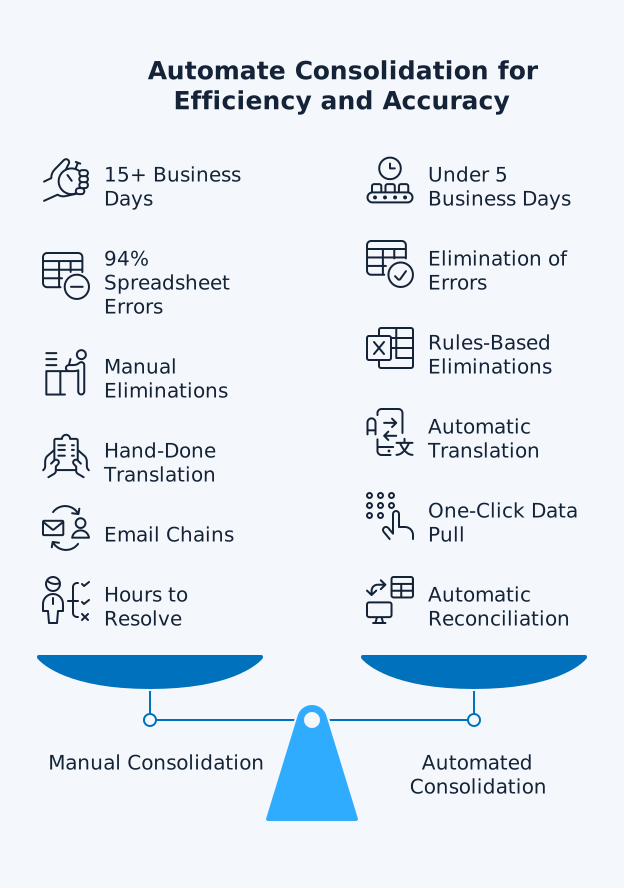
Manual consolidation processes are where most corporate finance teams lose time. The typical month-end close for a multi-entity group often takes 15 or more business days when relying on spreadsheets and manual data extraction.
Automation addresses each bottleneck in the consolidation workflow:
- Automated data collection: Replaces manual exports with direct connections to your accounting system, pulling financial data from multiple entities into a single database
- Standardised chart of accounts mapping: Aligns different subsidiary structures without manual rework
- Automated elimination entries: Handle intercompany transactions based on pre-configured rules
- Currency translation: Applies correct exchange rates automatically based on IAS 21 requirements
- Consolidated reporting: Generates balance sheets, income statements, and cash flow statements on demand
For corporate groups using Xero, dataSights automates the sync from multiple Xero entities into a secure, dedicated per-customer SQL database. This data flows into Management Reports in the dataSights web platform first, with additional automation available for Excel workflows and Power BI dashboards when you need custom analysis.
dataSights clients using automated consolidation often reduce their month-end close from over 15 days to under 5 days. With 80+ five-star reviews on the Xero App Store and 250+ businesses already connected, the platform handles everything from 3-entity groups to complex structures with 40+ entities.