Financial Consolidation Software: A Practical Guide for
Multi-Entity Finance Teams
In our work with mid-market finance teams running Xero
across multi-entity groups, we keep seeing the same
starting point: a Financial Controller who knows their
entities individually balance, a CFO who needs a group
P&L by Tuesday, and a workbook called
“Consol_v17_FINAL.xlsx” sitting between them. That gap,
between accurate single-entity ledgers and a defensible
group view, is the problem financial consolidation
software exists to solve. This guide explains what the
category actually does, the accounting standards that
shape it, and the mechanics of how the software handles
intercompany eliminations, foreign currency translation,
and non-controlling interest. The goal is not to sell a
tool. It is to give Financial Controllers, CFOs, and BI
Report Developers a clear mental model of the category
before they buy anything
What Is a Financial Consolidation Software?
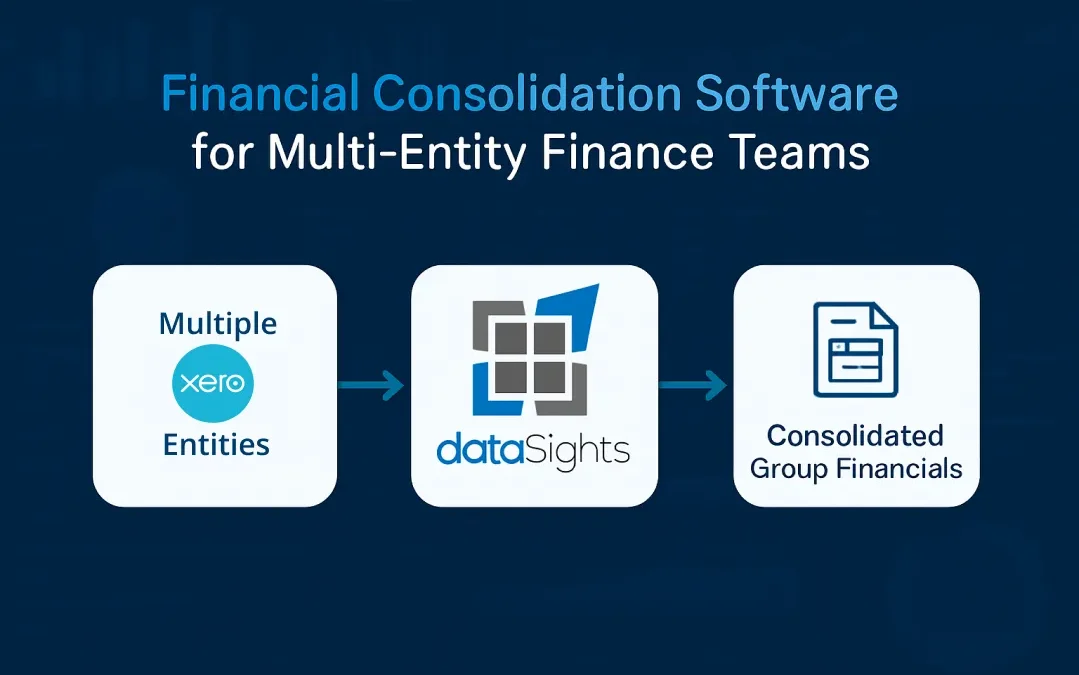
Financial consolidation software helps multi-entity
finance teams combine entity-level accounts into one
controlled group view. It typically handles Trial
Balance ingestion, chart-of-accounts mapping,
intercompany eliminations, FX translation, NCI
treatment, audit trails, and consolidated reporting. For
Xero groups, platforms such as dataSights sit above
separate Xero organisations and turn source-ledger data
into board-ready Management Reports, Excel workflows,
and Power BI analysis from the same reconciled dataset.
Ready to Automate Your Financial Consolidation?
Stop wrestling with manual consolidations and broken
formulas. dataSights automates multi-entity reporting,
Xero consolidations, and Power BI connections. Join 250+
businesses already transforming their financial
reporting with our platform, rated 5.0 out of 5 by 80+ verified Xero users.
What Financial Consolidation Software Actually Does
A useful way to evaluate financial consolidation
software is to ask what part of the close process it
controls. At minimum, it should ingest Trial Balance
data, standardise accounts, apply configured
eliminations, translate foreign entities, and produce
reports that finance teams can trace back to source. In
a dataSights setup, this workflow runs through a
dedicated Azure SQL database, giving finance teams a
controlled layer between Xero and the reports sent to
directors, auditors, and management.
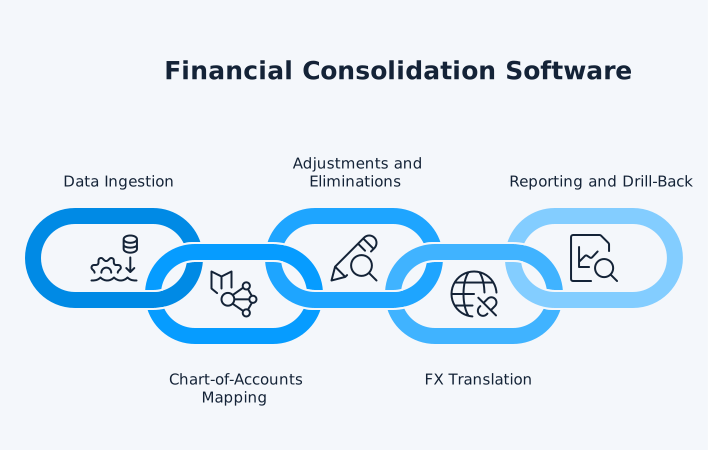
A practical definition starts with the five distinct
jobs the software performs.
Data ingestion: The platform pulls financial
data, ideally transactional rather than only trial-balance,
from each entity's source ledger on a defined schedule.
Schedules are typically configurable, ranging from every
30 minutes to once daily, depending on entity volume.
Chart-of-accounts mapping: Each entity
may have evolved its own chart of accounts. The software
harmonises divergent accounts into a group reporting structure
so that "Marketing – Online" in Entity A and "Digital
Marketing Spend" in Entity B both roll up into one consolidated
line.
Adjustments and eliminations: The platform
applies intercompany eliminations, non-controlling interest
allocation, and consolidation adjustments through configured
rules rather than through formulas in a spreadsheet that
someone has to remember to update.
Foreign currency translation: Where a
foreign subsidiary's functional currency differs from
the group's presentation currency, the software applies
the correct translation method for each balance type.
Translation differences arising on consolidation of the
foreign operation are recognised in other comprehensive
income (OCI) and accumulated in a foreign currency translation
reserve. This is distinct from exchange differences on
foreign currency transactions within an individual entity,
which are generally recognised in profit or loss.
Reporting and drill-back: It produces
a group P&L, balance sheet, and cash flow that a user
can drill back from a single consolidated number to a
source transaction in a specific entity.
Equally important is what the software does not do.
Compliance with IFRS or US GAAP is not guaranteed, as it
depends on how the finance team:
Configures accounting policies
Applies professional judgment (e.g., materiality and
control assessments)
Maintains effective internal controls
The software supports the workflow. It does not replace
the judgment.
The Accounting Standards That Shape the Category
The features that distinguish financial consolidation
software from a basic multi-entity reporting tool exist
because of specific requirements in international
accounting standards. Three are particularly
load-bearing.
The Accounting Standards That Shape the Category
IFRS 10 and the Control Test
Under IFRS 10, a parent must consolidate any entity it controls,
defined as having power over the investee, exposure to
variable returns, and the ability to use that power to
affect those returns. The equivalent under US GAAP is
ASC 810. It uses two primary models to identify a
controlling financial interest: the voting interest
entity model and the variable interest entity (VIE)
model. The control test, not ownership percentage, is
the trigger for consolidation. An entity holding 49% of
the shares may still control a subsidiary through
contractual rights and must consolidate; an entity
holding 60% may lack control through restrictive
shareholder agreements and apply the equity method
instead.
This matters for software design because the platform
must let you assemble the consolidation perimeter on the
basis of control. It must support full consolidation for
subsidiaries, the equity method for associates and joint
ventures, and recognition of the investor’s share of
assets, liabilities, revenues, and expenses for joint
operations. A tool that only knows how to add up
percentages will misstate the group.
IAS 21 and Foreign Currency Translation
Under IAS 21, consolidating a foreign subsidiary requires
translating its financial statements from its functional
currency into the group’s presentation currency using a
specific method. Income and expenses translate at the
exchange rates on the dates of the transactions. An
average rate for the period is commonly used as a
practical approximation, provided exchange rates do not
fluctuate significantly within the period. Balance sheet
items, with the exception of equity, translate at the
closing rate. Equity translates at historical rates. The
resulting translation differences are recognised in
other comprehensive income and accumulated in a foreign
currency translation reserve until disposal.
A worked example makes one of these mechanics concrete.
A UK parent consolidates a US subsidiary. The
subsidiary’s $1,000,000 revenue translates at the
average rate for the period (say, £0.79), giving
£790,000. Its $500,000 closing assets translate at the
closing rate (say, £0.81), giving £405,000. The
difference between the rates used for income and
expenses and the closing rate used for assets and
liabilities is one source of translation differences.
Other sources include retranslating opening net assets
at the new closing rate, plus the translation of
goodwill and other foreign operation balances. All these
differences flow to the foreign currency translation
reserve in equity, not to profit or loss.
Intercompany Eliminations and Unrealised Profit
When two entities in the same group transact, the
activity must be eliminated on consolidation because
the group has not transacted with the outside world.
Consolidation software handles three categories of
intercompany activity:
Intercompany sales and costs: Entity
A sells services to Entity B for £100,000. On consolidation,
both the £100,000 revenue in Entity A and the £100,000
expense in Entity B are eliminated. The group has
not earned anything from itself.
Intercompany loans: Parent lends
£500,000 to a subsidiary at 5% annual interest. Both
the £500,000 loan balance (asset in Parent, liability
in subsidiary) and the £25,000 interest income/expense
eliminate on consolidation. No cash has entered or
left the group.
Unrealised profit on inventory: Entity
A sells £50,000 of inventory to Entity B at a £10,000
markup. Entity B has not resold it by year-end. The
£10,000 unrealised profit must be eliminated from
consolidated inventory and group profit, because the
group cannot recognise profit on a transaction with
itself.
A separate elimination category is non-controlling
interest (NCI). When a parent owns 80% of a
subsidiary that reports £100,000 profit after
eliminations, the full £100,000 appears on the
consolidated income statement, but £20,000 is
attributed to non-controlling interests on the face
of the statement. On the balance sheet, NCI appears
as a separate equity line.
How the Mechanics Work in Practice
Once the standards are clear, the software's job is to apply
them consistently every period without manual intervention.
Three implementation details determine whether a platform
actually delivers this.
Mapping Layer
In Xero groups we have onboarded, a 12-entity group often
has 7 to 9 distinct chart-of-accounts variants once you look
closely. The mapping layer is where the software either
holds the line or quietly leaks. Strong platforms maintain a
stable group chart, allow each entity's local accounts to be
remapped without rebuilding the consolidation, and surface
unmapped accounts as exceptions before they reach the
consolidated trial balance.
Elimination Engine
The elimination engine should be configurable,
deterministic, and traceable. Configurable means that
finance, not IT, can define elimination rules for new
intercompany account pairs. Deterministic means the same
input produces the same output every time, with no
probabilistic matching feeding the audited number. Traceable
means each elimination posts as an identifiable journal that
an auditor can examine.
Some platforms now market AI-based intercompany matching. AI
is a useful triage layer for surfacing likely matches across
entities that have not coded a transaction consistently, but
the elimination itself, the journal that hits the
consolidated balance sheet, should be the result of a
configured rule that a human can step through. dataSights
takes this position deliberately: AI Data Jobs run as
deterministic exception checks rather than agents that post
journals on their own, so the consolidated number remains
defensible to external audit.
Drill-Back to Source Transaction
Every tool in the category claims an audit trail. The
functional question is more specific: from a single line on
the consolidated P&L, can you reach the underlying
journal in the underlying entity in three clicks or fewer?
Many tools stop at the trial-balance level. That can support
management reporting and parts of an audit workflow when
underlying documentation is available elsewhere.
Transaction-level drill-back improves audit readiness
materially, because the question an auditor asks is often
'show me the transaction' and the answer arrives in the same
system rather than across exports, source ledgers, and
supporting files.
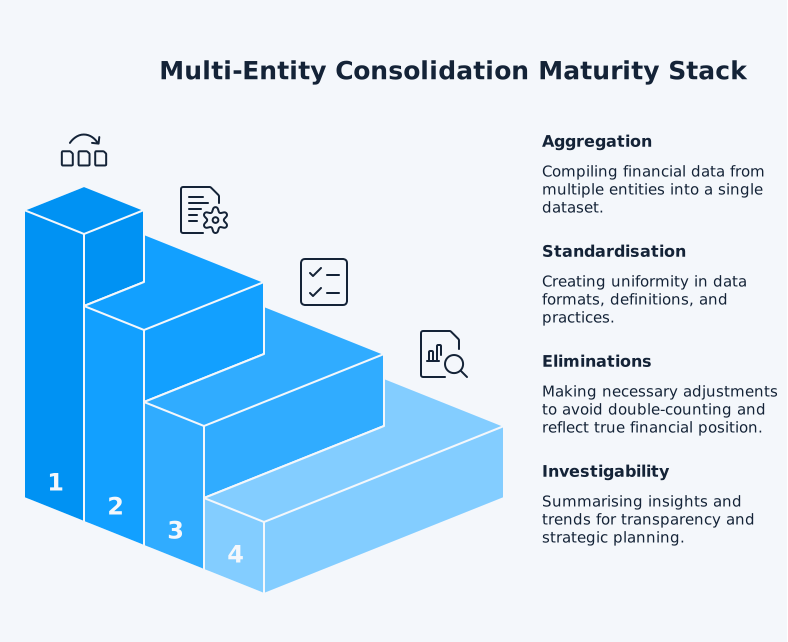
The Multi-Entity Consolidation Maturity Stack
A useful way to understand where any given finance team
currently sits is a four-layer model we apply when scoping
consolidation work for new dataSights customers. We call it
the Multi-Entity Consolidation Maturity Stack. Each layer
becomes less reliable the weaker the layer below it.
Layer 1: Aggregation. Pull numbers from each
entity into one place. A spreadsheet can do this for a few
entities. It is necessary and not sufficient.
Layer 2: Standardisation. Map divergent charts
of accounts, align cost-centre structures, and reconcile reporting
periods into a stable group view. Layer 2 is where most spreadsheet-based
consolidations break: someone changes an account code in one
Xero file, and the group report quietly mis-rolls for two
months.
Layer 3: Eliminations and Adjustments. Intercompany
sales, intercompany loans, unrealised profit, and NCI allocation.
The test is not whether the tool can post an elimination.
The test is whether elimination logic survives when one entity
reposts a journal in the source ledger on day six of close.
Layer 4: Investigability. When the auditor
asks, "Where does this £487,000 group revenue figure come
from?", how long does it take to answer? In a Layer 4 platform,
three clicks. In a Layer 1-2 platform with bolt-on Layer 3,
it is a Tuesday spent in spreadsheets.
When we onboard a 30+ entity group, the first thing we look
at is which layer their current process actually hits,
because the buying mistake we see most often is purchasing a
tool that promises Layer 3 but only delivers reliable Layers
1 to 2. The mismatch is invisible during the demo and
obvious during audit season.
Where Xero Sits in the Picture
Xero is the source ledger, not the consolidation engine.
Each legal entity lives in its own Xero organisation, which
works well for entity-level bookkeeping but does not create
a group reporting layer. That distinction matters because
consolidation requires a separate layer to handle:
The group chart of accounts
Elimination logic
Foreign exchange (FX) treatment
Non-controlling interest (NCI) calculations
Audit trail and adjustments
dataSights fills that gap by syncing each Xero organisation
into a dedicated Azure SQL database, then producing
consolidated Management Reports first. Excel automation and
Power BI are available for teams that need custom reporting,
spreadsheet-based workflows, or advanced analysis from the
same reconciled dataset.
The broader financial consolidation process covers the underlying mechanics in more detail for readers wanting
the step-by-step from trial-balance ingestion through consolidated
statements.
Common Misconceptions About the Category
Three misunderstandings recur often enough to be worth
naming.
1. Real-time consolidation
Marketing copy throughout the category uses "real-time"
loosely. In practice, most consolidation platforms refresh
data on a defined schedule rather than streaming each
transaction the instant it posts. dataSights, for example,
runs configurable scheduled refreshes typically ranging from
every 30 minutes to several hours depending on entity
volume. That cadence is fast enough for management reporting
and is not what an engineer means by real-time. The honest
term is near real-time or scheduled refresh.
2. AI replaces the consolidation engine
AI is genuinely useful for triaging intercompany mismatches,
flagging anomalous variances, and drafting commentary. It is
not a replacement for the deterministic accounting logic
that produces the audited number. A consolidated balance
sheet that depends on probabilistic matching is harder to
defend when an auditor asks how a specific number was
derived. The dataSights position, deterministic logic for
the consolidation itself with AI Data Jobs sitting on top as
exception checks, is the architecturally conservative choice
for finance teams whose external audits include scrutiny of
how material consolidation numbers are derived.
3. Consolidation software replaces the ERP
It does not. An ERP is the system of record for
transactions. Consolidation software sits above the ERP, or
above multiple Xero organisations, and produces group-level
reports. ERPs from larger vendors sometimes bundle a
consolidation module, but for groups standardised on Xero, a
dedicated consolidation layer is the standard pattern.
The Cost of Manual Consolidation
The category exists because manual consolidation has a
measurable cost, both in time and in error rate. According
to APQC's General Accounting Open Standards Benchmarking research, reported by CFO.com, the bottom quartile of finance teams
takes 10 or more calendar days to complete the monthly
close, against a median of around six. Separately, a 2024 peer-reviewed literature review by Poon and colleagues, published open-access in Frontiers of
Computer Science, found that around 94% of business spreadsheets
contained errors. Together, those numbers explain the demand for
the category: a manual workflow that takes a fortnight and produces
an error-prone output is a control weakness as well as a productivity
drag.
When teams replace manual consolidation with a platform that
genuinely covers Layers 1 to 4 of the maturity stack, the
close cycle compresses, the audit conversation shortens, and
the time saved redirects to analysis. Across dataSights
onboardings, some Xero groups have moved from over 15 days
at month-end close to under 5 once mapping, eliminations,
and drill-back sit in one platform with full transactional
history. Outcomes vary with the cleanliness of intercompany
coding coming in, the complexity of the group structure, and
how mature the team's pre-close processes already are. Our
explainer on the difference between consolidated and consolidating
reporting covers the underlying mechanics in more detail.
Frequently Asked Questions
Financial consolidation software is a
category of platform that aggregates
financial data from multiple legal entities,
applies group-level adjustments such as
intercompany eliminations and FX
translation, and produces consolidated
financial statements aligned with frameworks
such as IFRS 10 or ASC 810. The category
sits above general ledger systems and below
or alongside enterprise planning platforms.
No. Xero supports accounting for separate
entities as separate organisations, but
multi-entity consolidation requires an
additional reporting or consolidation layer.
Xero has no native intercompany module, no
automatic FX translation across
organisations, and no group-level
elimination engine. Eliminations must be
managed outside Xero, typically in multi-entity consolidation software or in spreadsheets.
Close software focuses on the workflow of
period-end accounting at the entity level:
task lists, sign-offs, reconciliations, and
journal approvals. Consolidation software
focuses on group-level outputs: aggregating
trial balances, eliminating intercompany
activity, and producing group financials.
The two categories overlap at the edges, and
several platforms cover both. For a Xero
group, the consolidation engine is usually
the binding constraint on close speed.
A single-entity business does not. For
multi-entity groups, a working rule of thumb
is that the case for dedicated consolidation
software emerges around 3 to 5 active
entities, the point at which manual
reconciliation across spreadsheets often
becomes the slowest part of close. The
trigger is rarely entity count alone. It is
more often a combination of more than one
functional currency, intercompany loans that need to balance, an external audit, or a board that wants
the consolidated pack on day 5 of the new
month.
Across dataSights onboardings of Xero groups
with 5 to 30 entities and reasonably clean
intercompany configuration, implementations
have typically run 2 to 6 weeks. The
variable that drives the curve is not the
software. It is the state of the source
data: chart-of-accounts alignment,
intercompany coding consistency, and
historical opening balances. Groups that
come in with clean data have reached a
working consolidated P&L in days. Groups
with messy intercompany take longer, because
the data work happens whether or not you
have the tool.
No. An ERP is the system of record for
transactions. Consolidation software sits
above the ERP, or above multiple Xero
organisations, and produces group-level
reports. ERPs from larger vendors sometimes
bundle a consolidation module, but for
groups standardised on Xero, a dedicated
consolidation layer is the standard pattern.
No. Consolidation software produces
consolidated financial statements; the
auditor opines on whether those statements
give a true and fair view under the relevant
framework. Stronger software shortens audit
preparation by giving the auditor a
traceable drill-back, but the audit judgment
itself is professional, not algorithmic.
Closing the Distance Between Numbers and Confidence
The gap between a finance team that closes in 5 days and one
that closes in 15 is shaped by many factors: audit scope,
group complexity, resourcing, data quality at source,
operating model, and the maturity of internal controls. One
factor sits squarely in the finance leader’s control,
though, and that is whether the group’s consolidation logic,
mapping, eliminations, FX translation, and drill-back, lives
in a single deterministic platform or in spreadsheets
stitched together each month. Once that logic moves into
software that covers all four layers of the maturity stack,
the conditions for a faster close and a shorter audit
conversation are materially better. That is the outcome the
category was built to enable, and it is the standard worth
holding any platform to.
Build a More Controlled Xero Consolidation Process
If your group reporting still depends on exported Trial
Balances, linked workbooks, and manual elimination journals,
the next step is not another spreadsheet template.
dataSights gives Xero finance teams a controlled
consolidation layer with board-ready Management Reports,
automated elimination workflows, Excel automation, and Power
BI-ready data from one reconciled source. . Rated 5.0 out of 5by 80+ Xero reviewers. Join 250+ businesses using
dataSights to automate reporting and consolidation workflows
in a deterministic, auditable platform.
I'm Kevin Wiegand, and with over 25 years of experience
in software development and financial data automation,
I've honed my skills and knowledge in building
enterprise-grade solutions for complex consolidation and
reporting challenges. My journey includes developing
custom solutions for data teams at Gazprom Marketing &
Trading and E.ON, before founding dataSights in 2016.
Today, dataSights helps over 250 businesses achieve 100%
report automation. I'm passionate about sharing my
expertise to help CFOs and Financial Controllers reduce
their month-end close time and eliminate the manual
Excel exports that drain their teams' valuable time.