Financial Consolidation: How to Automate Multi-Entity Reporting
by Kevin Wiegand
|
Apr 15, 2026
|
Xero
Home
|
Xero
|
Financial Consolidation: How to Automate Multi-Entity Reporting
Your subsidiaries report different numbers. Your balance sheets do not reconcile across entities. Month-end close stretches past two weeks while the board waits for consolidated reports. Financial consolidation is the process that fixes this – combining data from every entity into one set of statements so you can see the full picture and close faster. This guide covers the process step by step, the methods that apply to your ownership structure, the challenges that slow teams down, and how automation helps many finance teams move from multi-week consolidation cycles to closes completed in under 5 days, depending on group complexity and process maturity.
What Is Financial Consolidation?
Financial consolidation combines financial data from multiple subsidiaries, divisions or entities into one reconciled group view for the parent company. It brings together Trial Balance data, intercompany eliminations, currency translation and ownership adjustments so the group can produce statutory accounts, board packs and lender-ready reporting from the same foundation. Many finance teams reduce month-end close from over 15 days to under 5 once collection, eliminations and reporting are automated.
Ready to Automate Your Financial Consolidation?
Stop wrestling with manual consolidations and broken formulas. dataSights automates multi-entity reporting, Xero consolidations, and Power BI connections. Join 250+ businesses already transforming their financial reporting with our platform, rated 5.0 out of 5 by 80+ verified Xero users.
Why Financial Consolidation Matters for Multi-Entity Businesses
Accurate financial consolidation delivers measurable outcomes for your organisation. These are the four that CFOs and Financial Controllers track most closely.
Complete Visibility Across All Entities
Consolidated statements give you a single view of revenue, expenses, assets and liabilities across every subsidiary. Without consolidation, you make decisions based on fragments. With it, you can:
Compare entity performance side by side
Spot underperforming divisions before they affect group results
Allocate resources based on group-level data rather than individual snapshots
Faster, More Confident Decision-Making
When your finance team spends two weeks producing consolidated reports, the data is stale by the time it reaches the board. Automated consolidation delivers results in days. One dataSights client consolidated 72 Xero entities within 3 seconds and later scaled that setup to 139 entity connections. Across the platform, dataSights is used by 250+ businesses.
Regulatory Compliance and Audit Readiness
Both IFRS 10 and ASC 810 require consolidation when a parent controls another entity. Lenders often add consolidated reporting to loan covenants. Automated systems maintain the audit trails and documentation that satisfy both requirements.
Elimination of Manual Errors
Spreadsheet-based consolidation introduces errors at every step. These errors compound with each additional entity. Consolidation software applies consistent rules across all entities, every period, with full traceability.
Understanding the Financial Consolidation Process
Framework note: This section mainly references IFRS because most larger UK-listed groups apply UK-adopted IFRS. Groups using FRS 102 follow similar consolidation principles, but key differences around goodwill, NCI measurement and exemptions should be considered separately.
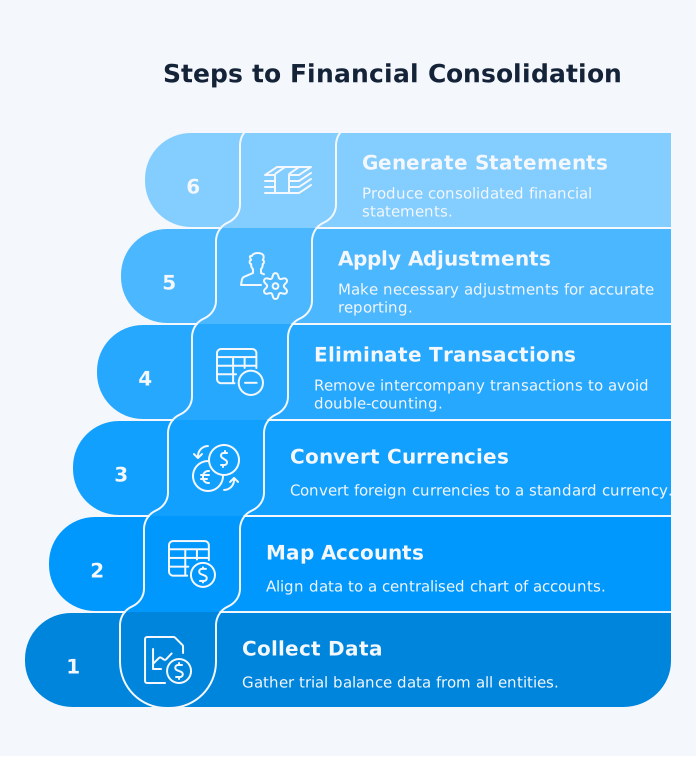
The journey from scattered entity data to polished consolidated statements follows six steps. This is the same sequence whether you are combining 3 entities or 30.
Step 1: Collect Trial Balance Data
Your consolidation begins by gathering trial balance data from every entity. Each subsidiary might use different accounting systems, currencies and chart of accounts structures. You need complete, accurate trial balances from all entities for the same reporting period.
The trial balance is the backbone of accurate consolidation – every consolidated number must reconcile back to entity-level trial balances. dataSights starts by pulling full trial balance data from each entity into a centralised, always-reconciled consolidation layer.
Step 2: Map to a Centralised Chart of Accounts
Align each entity’s accounts to your master chart of accounts. Subsidiaries often use different account structures based on local requirements. Account 1200 might represent inventory in one entity but accounts receivable in another. Standardising this mapping ensures consistency across your consolidated reports.
Step 3: Convert Foreign Currencies
For multinational operations, convert all financial data to your reporting currency.
Each subsidiary first reports in its functional currency, then translates into the group’s presentation currency for consolidation. Under IAS 21, the translation rules for a foreign operation are:
Assets and liabilities at the closing rate
Income and expenses at transaction-date rates, or an average rate where it is a reasonable approximation
Goodwill and fair value adjustments arising on acquisition of the foreign operation at the closing rate
Translation differences recognised in other comprehensive income and accumulated in the foreign currency translation reserve in equity
Example: An Australian parent with a UK subsidiary translates the subsidiary’s revenue at the average GBP/AUD rate for the period, while year-end assets translate at the closing rate. The resulting translation difference sits in equity, not operating profit.
Step 4: Eliminate Intercompany Transactions
When Company A sells to Company B within your group, both the revenue and expense must be eliminated to avoid double-counting. Common intercompany eliminations include:
Intercompany sales and purchases
Loans between entities
Management fees and service charges
Dividend payments between group companies
The direction matters for profit attribution. Downstream transactions (parent to subsidiary) reduce the parent’s profit without affecting non-controlling interest. Upstream transactions (subsidiary to parent) reduce the subsidiary’s profit and therefore also reduce the share attributed to non-controlling interests.
Example: Entity A sells inventory to Entity B for £50,000 at a £10,000 profit. If Entity B still holds that inventory at year-end, remove the £50,000 intercompany sale and eliminate the £10,000 unrealised profit from group inventory and group profit.
Note for Xero users: Xero supports basic intercompany bookkeeping between organisations, but automated matching, group-level eliminations and consolidated audit trails typically require a dedicated consolidation layer or add-on. Without that layer, teams managing eliminations across multiple Xero files in spreadsheets face the highest risk of reconciliation errors.
Step 5: Apply Consolidation Adjustments
Make adjustments for partial ownership, goodwill and fair value changes. If you own 80% of a subsidiary, record the 20% non-controlling interest separately.
Example: Parent owns 80% of Sub A. Sub A earns $100,000 profit. The consolidated income statement reports the full $100,000, but $20,000 is attributed to non-controlling interest. On the balance sheet, NCI appears as a separate equity line.
Under IFRS 3, goodwill is measured as:
(Consideration transferred + Non-controlling interest + Fair value of any previously held equity interest) – Fair value of identifiable net assets acquired
For a straightforward 100% acquisition, this simplifies to purchase price minus net assets. For partial acquisitions or step acquisitions where you already held an interest before gaining control, the full calculation applies.
If subsidiaries have different reporting dates, IFRS 10 permits up to a 3-month difference when alignment is impracticable, with adjustments for significant transactions in the gap period.
Consolidation Methods: Choosing Your Approach
Your ownership percentage and control level determine which consolidation method to apply.
Full Consolidation Method
Under IFRS 10 and ASC 810, you apply full consolidation when the parent controls the subsidiary. Control means power over relevant activities, exposure to variable returns and the ability to use that power to affect those returns. Ownership above 50% often indicates control, but is not the test on its own. You include 100% of the subsidiary’s financials, with minority ownership shown as non-controlling interest.
Equity Method
Where you have significant influence but not control – typically 20% or more of voting power – apply the equity method under IAS 28. You recognise your share of the investee’s profits or losses in a single line in the income statement and adjust the carrying amount accordingly. Joint ventures under IFRS 11 also use the equity method.
Proportionate Consolidation
Replaced by the equity method under current IFRS since 2013. Previously allowed you to include your percentage share of joint venture assets and liabilities. IFRS 11 now requires the equity method for joint ventures.
Method Comparison at a Glance
Method
Control Level
Typical Indicator
Statement Treatment
Standard
Full Consolidation
Control
Control, often evidenced by majority voting rights or other power
Significant influence, often presumed at 20% or more
Single line in P&L; investment adjusted on balance sheet
IAS 28 / ASC 323
Proportionate (historical)
Joint control
Varies
Pro-rata share (now replaced by equity method)
Replaced by IFRS 11
When Is Financial Consolidation Required?
Consolidation is required whenever a parent entity controls one or more subsidiaries. Under IFRS 10 and ASC 810, control means:
Power over the investee’s relevant activities
Exposure to variable returns from that involvement
Ability to use that power to affect those returns
Even a group of just two entities – one parent and one subsidiary – triggers the requirement. There is no minimum size or entity-count threshold beyond the control relationship itself.
Exemptions exist, but they are jurisdiction-specific. In the UK, the small-group exemption comes from the Companies Act 2006. For accounting periods beginning on or after 6 April 2025, a parent company may be exempt from preparing group accounts if the group meets at least two of these Companies Act size tests:
Aggregate turnover of no more than £15 million net (£18 million gross)
Aggregate balance sheet total of no more than £7.5 million net (£9 million gross)
No more than 50 employees on average
FRS 102 then affects the accounting treatment and disclosures if the group does prepare consolidated accounts.
Even where statutory consolidation is not required, many Xero-based groups prepare management consolidations for boards, lenders and investors. Bank covenants frequently require consolidated reporting regardless of exemption status.
Common Financial Consolidation Challenges
Manual consolidation creates bottlenecks that compound with each additional entity.
1. Data Quality and Consistency Issues
Manual data entry across spreadsheets introduces errors that cascade through your consolidation. Common failure points:
Different entities interpret account classifications differently
Exchange rates applied inconsistently across files
Version control breaks down when multiple team members edit separate spreadsheets
A single misclassified account in one subsidiary can throw off your entire consolidated trial balance. Finding the source often takes longer than the original consolidation.
2. Time-Consuming Manual Processes
Research from FP&A Trends shows that only about 35% of FP&A professionals’ time goes to high-value insight work. The rest is consumed by data collection and validation. For multi-entity groups, the consolidation process itself is often the single largest time drain in the month-end close.
3. Complex Intercompany Eliminations
As entity counts rise, the number of potential intercompany pairs increases fast:
10 entities = 45 potential pairs
20 entities = 190 potential pairs
Each pair can generate multiple balances, charges, loans and timing differences that need review.
Missing even one transaction compromises the entire consolidation. Manual tracking lacks the audit trail required for compliance.
4. Regulatory Compliance Complexity
IFRS and GAAP have subtle but important differences in consolidation rules. UK entities following FRS 102 face additional requirements. Maintaining compliance across multiple standards while meeting reporting deadlines is difficult even for experienced teams.
5. Currency Translation Complications
Applying correct exchange rates to different statement items creates complexity. Balance sheet items need period-end closing rates. Income items need average rates. IAS 21 requires specific treatment for goodwill and fair value adjustments from foreign subsidiary acquisitions.
How Financial Consolidation Software Transforms Your Close
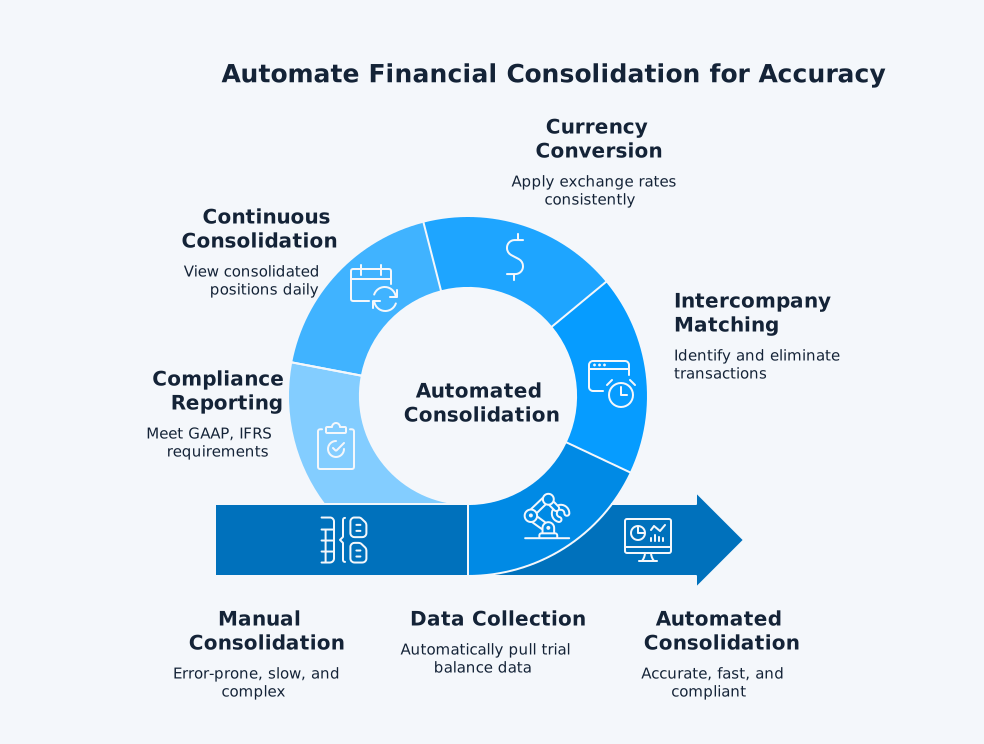
Modern consolidation platforms automate the heavy lifting. Here is what changes when you move beyond spreadsheets.
Automated Data Collection and Validation
Consolidation software connects directly to your source systems, pulling trial balance data from all entities automatically. Built-in validation rules flag discrepancies immediately. No more chasing subsidiaries for updated spreadsheets.
Intelligent Intercompany Matching
Software identifies and eliminates intercompany transactions using predefined rules:
Automatic matching by counterparty, account, currency and period
Tolerance and date-window settings for near-matches
Full audit trails documenting every elimination
Near Real-Time Currency Conversion
Automated systems apply appropriate exchange rates based on transaction types. Historical rates, spot rates and average rates get applied consistently across all entities based on schedule refresh.
Continuous Consolidation Capability
Instead of waiting until month-end, view consolidated positions daily. Issues surface immediately rather than two weeks after close. Month-end becomes a confirmation step rather than a discovery exercise.
Compliance-Ready Reporting
Built-in templates, documented logic and audit trails support IFRS, GAAP and FRS 102 consolidation workflows when configured to your group’s accounting policies.
From Consolidated Statements to Board-Ready Management Reports
Consolidation is not only about statutory accounts. Finance leaders also need:
Board packs
Variance analysis
Cash visibility
AR/AP rollups
KPI reporting from the same reconciled group data
dataSights turns consolidated Trial Balance data into management packs delivered through the web platform first, with Excel automation and Power BI available for teams that need those additional layers.
Meeting GAAP, IFRS and FRS 102 Requirements
Compliance is not optional when preparing consolidated statements. These requirements matter operationally because finance teams must apply the same logic every close. Automated mappings, documented eliminations and historical snapshots make that application repeatable and easier to audit.
IFRS 10: Consolidated Financial Statements
IFRS 10 requires consolidation when you control another entity. Control means power over investees, exposure to variable returns and the ability to affect those returns.
IFRS 10 also requires a parent to apply uniform accounting policies across all group entities. Reporting date differences of up to three months are permitted, but adjustments are required for significant transactions in the gap period.
ASC 810 Under US GAAP
ASC 810 uses a dual model: the voting interest model for traditional subsidiaries and the variable interest entity (VIE) model for special purpose entities. This two-tier approach can produce different consolidation conclusions than IFRS.
FRS 102 for UK Entities
UK companies following FRS 102 have consolidation requirements broadly aligned with IFRS, with some simplifications. Small groups meeting Companies Act 2006 size thresholds may be exempt from statutory consolidation.
Key Compliance Considerations
Both IFRS and GAAP frameworks require:
Complete elimination of intercompany transactions
Uniform accounting policies across consolidated entities
Aligned reporting dates for all included entities (IFRS 10 permits up to a 3-month difference when alignment is impracticable, with adjustments for significant intervening transactions)
Clear disclosure of consolidation principles
Separate presentation of non-controlling interests
Accelerating Your Month-End Close
The path from 15-day closes to 5-day closes is not about working harder. It is about the right processes and tools. One dataSights client consolidated 72 Xero entities within 3 seconds and scaled to 139 across 250+ businesses.
Implement Continuous Close Practices
Spread close activities throughout the period:
Reconcile accounts weekly
Review intercompany transactions as they occur
Address variances immediately
Month-end becomes a confirmation step, not a discovery exercise.
Standardise Across All Entities
Create uniform charts of accounts, accounting policies and reporting templates across all subsidiaries. Even small differences in account naming conventions create friction that compounds across entities.
Automate Repetitive Tasks
Focus automation on high-volume processes: journal entries, reconciliations and eliminations. Your team concentrates on exceptions and analysis. The dataSights process automation capabilities handle these tasks across your connected entities.
Establish Clear Workflows
Define task ownership, dependencies and deadlines for every close activity. Workflow tools track progress and highlight bottlenecks before they delay your close.
Monitor Key Metrics
Track these indicators to measure improvement:
Close cycle time by entity
Days to consolidate
First-pass accuracy rates
See how automated consolidation manages eliminations and generates management reports across multiple entities:
Frequently Asked Questions
Financial consolidation combines financial statements from multiple entities under common control. Business consolidation involves legally merging separate companies into one entity. Financial consolidation keeps entities legally separate but reports them as one for financial purposes.
Public companies typically consolidate more frequently to meet listing requirements. ASX-listed companies report half-yearly under the Corporations Act, while UK-listed companies produce half-yearly reports under the FCA’s Disclosure and Transparency Rules. US-listed domestic issuers file quarterly.
Consolidation is required when a parent controls another entity. Under IFRS 10 and ASC 810, control means power over relevant activities, exposure to variable returns and the ability to use that power to affect those returns. You may also need to consolidate entities you control through contractual rights or variable interests, even without majority ownership.
Associates and joint ventures are usually not fully consolidated. Where you have significant influence but not control, or joint control, you generally use the equity method instead. That means the consolidated balance sheet shows a single investment line, and the consolidated income statement shows your share of profit or loss rather than line-by-line consolidation.
Yes, but you must convert all entities to use uniform accounting policies for the consolidated statements. This often means adjusting subsidiary statements to match the parent’s framework. IFRS 10 specifically requires this alignment.
The core categories are intercompany balances, intercompany revenue and cost, and investment elimination entries that remove the parent’s investment against subsidiary equity. A fourth high-risk area is unrealised profit in inventory or fixed asset transfers, which must be removed until the asset is sold outside the group. Xero supports basic intercompany bookkeeping, but automated matching and group-level eliminations are typically managed in a dedicated consolidation or reporting layer.
You still consolidate 100% of the subsidiary’s financials if you have control. The portion you do not own is recorded as non-controlling interest. Example: Parent owns 80% of Sub A (profit $100k). Consolidated income = $100k, but $20k appears as NCI.
Two. A parent company and one subsidiary under common control is enough. There is no minimum threshold beyond that.
It depends on jurisdiction. In the UK, small groups may be exempt under the Companies Act 2006. In Australia and New Zealand, certain intermediate parents may be exempt from preparing consolidated statements where a higher-level parent produces publicly available consolidated financial statements that comply with the relevant reporting framework. Even if not legally required, many Xero-based groups prepare management consolidations for boards and lenders.
Ideally, all group entities report for the same period as the parent. IFRS 10 allows a maximum 3-month difference. You must adjust for significant transactions in the gap period.
Goodwill appears only in consolidated statements, not individual entity ledgers. Under IFRS 3 and ASC 805, goodwill is measured as the excess of consideration transferred, plus any non-controlling interest and previously held equity interest, over the fair value of identifiable net assets acquired. Under IFRS, goodwill is tested annually for impairment rather than amortised. Under FRS 102, goodwill is amortised over its useful economic life.
No. Under IFRS, goodwill is recognised on acquisition and then tested for impairment. Under FRS 102, goodwill is amortised systematically over its useful economic life. Where that life cannot be estimated reliably, the presumption is a period not exceeding 10 years. UK GAAP groups should not assume the IFRS impairment-only treatment applies.
Statutory consolidation produces the formal accounts required by law – IFRS, GAAP or local frameworks, subject to external audit. Management consolidation produces internal reports for leadership. Management consolidations may include additional KPIs, segmented analysis or non-GAAP measures. Many organisations run both from the same data set.
Yes. Modern multi-entity consolidation software handles multi-currency translation, partial ownership with NCI calculations and intercompany eliminations across any number of entities. dataSights clients consolidate across multiple currencies and ownership structures, with eliminations and NCI adjustments applied automatically.
Master Financial Consolidation Without the Month-End Marathon
Financial consolidation does not have to consume weeks of your team’s time. Standardise your chart of accounts, automate intercompany eliminations and build audit trails that satisfy both internal stakeholders and external auditors. Whether you are consolidating 3 entities or 130, the fundamentals stay the same: accurate trial balances, consistent mappings, precise eliminations, compliant reporting. The difference between a 15-day close and a 5-day close comes down to how much of that process is automated. Your consolidated statements become assets for decision-making, not compliance burdens.
Transform Your Financial Consolidation with Automated Xero Integration
dataSights delivers consolidated management packs through our web platform first, including Profit and Loss, Balance Sheet, Trial Balance, AR/AP, Budget and Variance reporting. For teams that work in spreadsheets, Excel automation through the Office Add-In and Power Query keeps reports current without CSV exports. Power BI remains available for advanced visualisation. Rated 5.0 out of 5 by 80+ verified Xero users and trusted by 250+ businesses. Many teams reduce month-end close from over 15 days to under 5, depending on group complexity and process maturity.
I’m Kevin Wiegand, and with over 25 years of experience in software development and financial data automation, I’ve honed my skills and knowledge in building enterprise-grade solutions for complex consolidation and reporting challenges. My journey includes developing custom solutions for data teams at Gazprom Marketing & Trading and E.ON, before founding dataSights in 2016. Today, dataSights helps over 250 businesses achieve 100% report automation. I’m passionate about sharing my expertise to help CFOs and Financial Controllers reduce their month-end close time and eliminate the manual Excel exports that drain their teams’ valuable time.