First Time Consolidation of Financial Statements: 2026 Guide
by Kevin Wiegand
|
February 25, 2026
|
Financial Consolidation
home
|
Financial Consolidation
|
First Time Consolidation of Financial Statements: 2026 Guide
Your group just acquired a new subsidiary. Or your business has grown from a single entity into a multi-company structure. Either way, the task ahead is clear: you need to prepare consolidated financial statements, and you have never done it before. The first time consolidation of financial statements can feel like a steep climb, with intercompany eliminations, uniform accounting policies, and compliance requirements all landing on your desk at once. This guide walks you through every step of the process, from determining whether consolidation is required to producing audit-ready group accounts. Read on to see exactly how to get your first consolidation right.
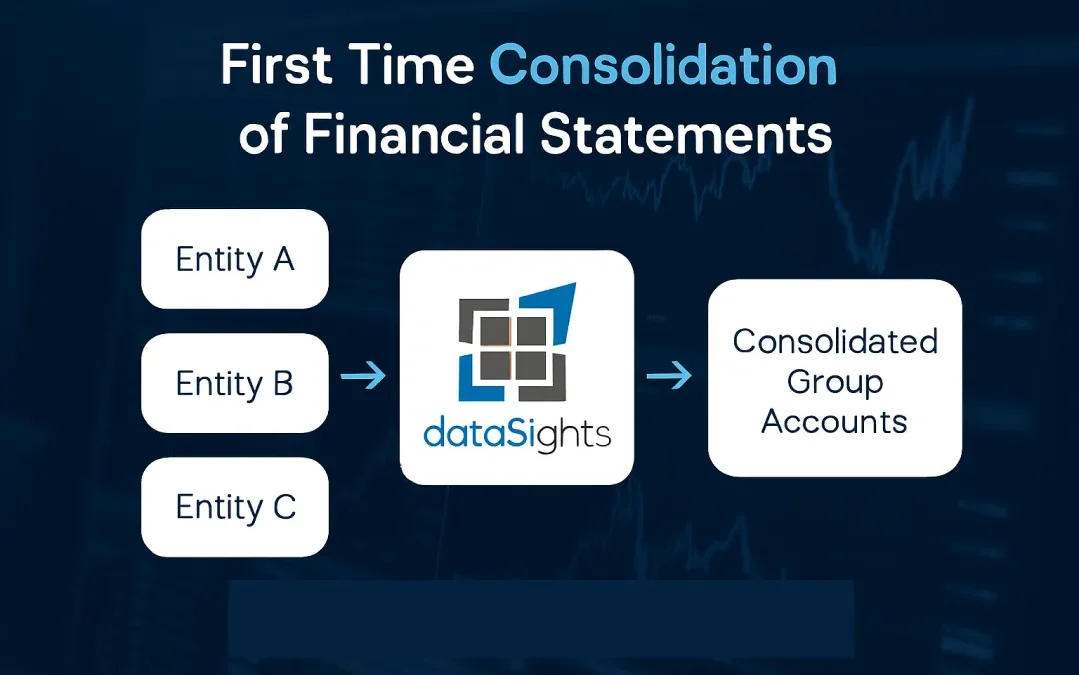
First time consolidation of financial statements is the process of combining a parent and its subsidiaries into a single set of group accounts, including eliminations and acquisition accounting. You’ll typically need it when you gain control of another entity, or when a restructure creates a new parent-subsidiary group. Use the steps below to prepare clean source trial balances, apply consistent policies, eliminate intercompany activity, and produce audit-ready consolidated statements.
Getting your first time consolidation of financial statements right is worth the upfront effort. The group structure you map, the accounting policies you align, and the intercompany processes you establish will serve your finance team for years. Whether you manage 3 entities or 30, the fundamentals remain the same: standardise, eliminate, combine, and reconcile. The difference between a painful first consolidation and a smooth one often comes down to preparation and the right tools. With the right consolidation process in place, every subsequent period gets faster and more reliable.
Ready to Automate Your Financial Consolidation?
Stop wrestling with manual consolidations and broken formulas. dataSights automates multi-entity reporting, Xero consolidations, and Power BI connections. Join 250+ businesses already transforming their financial reporting with our platform, rated 5.0 out of 5 by 80+ verified Xero users.
When Does First Time Consolidation Become Required?
The trigger for first time consolidation is gaining control over another entity. Under IFRS 10, control exists when a parent has all three of these elements:
Power over the investee
Exposure or rights to variable returns
The ability to use its power to affect those returns
In practical terms, you will need to prepare consolidated financial statements when any of the following events occur:
Your company obtains control of another entity (often via >50% voting rights, but sometimes via contractual rights, board control, or other arrangements)
Your group structure changes, giving you control over an entity you previously held as an associate or joint venture
A restructuring creates a new holding company above existing subsidiaries
Your business grows organically by establishing new subsidiary entities
Under the UK Companies Act 2006, a UK parent company generally must prepare group accounts at the year-end unless an exemption applies (for example, certain small groups or where the parent is itself included in higher-level group accounts). Private companies may also be required to consolidate where they meet certain size thresholds.
Not every parent entity must consolidate. Under IFRS 10, a parent is exempt from presenting consolidated financial statements only if all of the following conditions are met:
It is a wholly-owned subsidiary, or a partially-owned subsidiary and all other owners (including those without voting rights) have been informed and do not object to the parent not presenting consolidated financial statements.
Its debt or equity instruments are not traded in a public market.
It is not in the process of filing its financial statements with a securities regulator for the purpose of issuing instruments in a public market.
Its ultimate or any intermediate parent produces consolidated financial statements that comply with IFRS and are available for public use.
How to Prepare for Your First Consolidation
Preparation is where most first-time consolidations succeed or fail. Before you combine a single number, you need to lay the groundwork across your group entities.
1. Map Your Group Structure
Start by documenting every entity in your group, including ownership percentages, acquisition dates, and functional currencies. This group structure map becomes your reference document for the entire consolidation.
2. Align Accounting Policies
All entities in your group must use uniform accounting policies for the consolidated financial statements. If your UK parent uses straight-line depreciation but your Australian subsidiary uses diminishing balance, one of them needs to change for consolidation purposes. Identify these differences early and prepare the adjusting entries before your first close.
3. Standardise Your Chart of Accounts
A unified chart of accounts makes consolidation dramatically simpler. When Entity A codes office rent to account 5010 and Entity B codes it to 6200, your elimination and consolidation workings become unnecessarily complex. Standardising across entities before your first consolidation saves hours of mapping work every month thereafter. dataSights supports multi-entity Xero reporting by syncing all entities into a single structured data model, making chart of accounts alignment straightforward.
4. Identify Intercompany Transactions
Catalogue every transaction between group entities:
Intercompany sales and purchases
Management fees
Loan balances
Interest charges
You will need to eliminate all of these on consolidation. Missing even one intercompany balance means your consolidated balance sheet will not balance.
For example, if Entity A sells services to Entity B for £100,000, both the £100,000 revenue in Entity A and the £100,000 expense in Entity B are eliminated on consolidation. The group has not earned anything from itself.
See how dataSights automates Xero consolidation for multi-entity groups in this walkthrough.
Step-by-Step First Time Consolidation Process
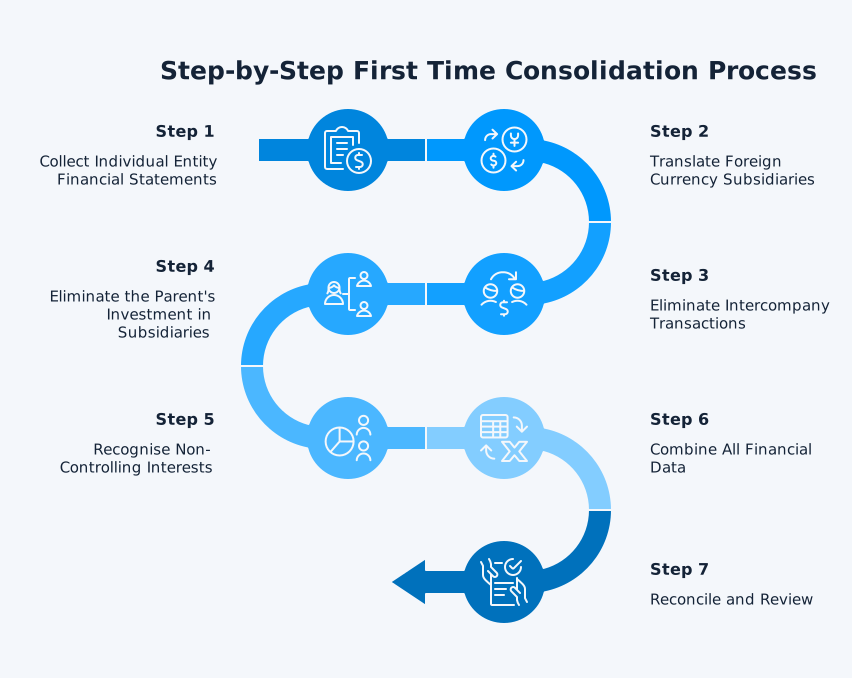
Once your preparation is complete, follow these steps to produce your first set of consolidated financial statements.
Gather the trial balances, income statements, balance sheets, cash flow statements, and statements of changes in equity from every subsidiary. All statements should cover the same reporting period and use the same accounting policies. Where a subsidiary has a different year-end, IFRS 10 permits a maximum three-month lag if the subsidiary cannot prepare statements for the parent’s reporting date. If subsidiaries have different reporting dates, align them where practicable – and if you must use a subsidiary’s most recent financials, adjust for significant intervening transactions. Under IFRS 10, the reporting-date gap should be no more than three months.
Step 2: Translate Foreign Currency Subsidiaries
If any subsidiary reports in a currency different from your group’s presentation currency, translate its financial statements under IAS 21. Apply the average exchange rate for the period to income statement items, and the closing rate at the balance sheet date for assets and liabilities. The resulting exchange difference goes to the cumulative translation adjustment in equity.
In practice, equity components (for example, share capital) are often translated at historical rates, while translation differences are recognised in OCI and accumulated in equity until disposal of the foreign operation.
For example, a UK parent consolidating a US subsidiary would translate $1m revenue at the average rate (say, £0.79), giving £790,000. The subsidiary’s $500,000 in assets would translate at the closing rate (say, £0.81), giving £405,000. The difference flows to the translation reserve.
Step 3: Eliminate Intercompany Transactions
Remove all intra-group balances and transactions. This includes intercompany receivables and payables, intercompany revenue and expenses, intercompany loans and interest, intercompany dividends, and unrealised profit on inventory still held within the group.
For example, if Entity A sells £50,000 of inventory to Entity B at a £10,000 markup, and Entity B has not resold it by year-end, the £10,000 unrealised profit must be eliminated from consolidated inventory and group profit.
Automated consolidation software handles these elimination entries based on pre-configured rules, removing the manual risk of missed or incorrectly calculated eliminations.
Step 4: Eliminate the Parent’s Investment in Subsidiaries
Replace the parent’s “investment in subsidiary” balance with the subsidiary’s net assets at fair value on the acquisition date. The difference between the purchase price and the fair value of net assets acquired is recognised as goodwill on the consolidated balance sheet under IFRS 3.
If the fair value of identifiable net assets exceeds the consideration transferred, IFRS 3 treats this as a bargain purchase, recognised in profit or loss (after reassessing measurements).
For example, if the parent pays £800,000 for 100% of a subsidiary with net assets of £600,000, the £200,000 difference is recognised as goodwill.
Step 5: Recognise Non-Controlling Interests
If the parent owns less than 100% of a subsidiary, the portion belonging to outside shareholders is reported as non-controlling interest (NCI) in both equity and the income statement. NCI is measured at either fair value or the proportionate share of net assets at the acquisition date, as permitted by IFRS 3.
For example, if the parent owns 80% of a subsidiary that reports £100,000 profit after eliminations, the full £100,000 appears on the consolidated income statement, but £20,000 (20%) is attributed to non-controlling interests.
Step 6: Combine All Financial Data
Add together the adjusted financial statements of every entity in the group. After all eliminations and adjustments, the combined figures should present the group as a single economic entity. Your consolidated output includes:
Consolidated income statement
Consolidated balance sheet
Consolidated cash flow statement
Consolidated statement of changes in equity
Step 7: Reconcile and Review
Verify that your consolidated balance sheet balances. Check that total equity equals total assets minus total liabilities. Confirm all intercompany balances have been fully eliminated by reviewing that no intra-group receivable or payable remains. Run a Trial Balance reconciliation to confirm every entity’s data ties back to its source.
dataSights maintains Trial Balance reconciliation throughout the consolidation process, ensuring your consolidated statements always tie back to the original Xero data.
Common First Time Consolidation Mistakes
First-time consolidators consistently encounter the same pitfalls. Knowing what to watch for helps you avoid them.
Inconsistent accounting policies across entities: Align revenue recognition, depreciation methods, capitalisation thresholds, and lease accounting so the group is comparable.
Not documenting consolidation journals and eliminations: Keep an audit trail of every elimination and adjustment (what, why, and source).
Incomplete intercompany identification: Missed intercompany transactions create imbalances that can take hours to trace. Maintain a comprehensive intercompany transaction register from day one.
Incorrect foreign exchange treatment: Using the closing rate for income statement items (instead of the average rate) or forgetting the cumulative translation adjustment are frequent first-time errors.
Goodwill miscalculation: Failing to properly identify and fair-value the subsidiary’s net assets at acquisition leads to incorrect goodwill recognition, which has flow-on effects for impairment testing.
Attempting manual consolidation in spreadsheets: In year one, spreadsheets amplify formula and version-control risk and weaken the audit trail. In a review of seven field audits covering 88 spreadsheets, errors were found in 94% of the audited files. Deloitte research also highlights the wider problem: finance teams can spend a significant share of their time creating and updating reports rather than analysing results.
Automating Your First Time Consolidation
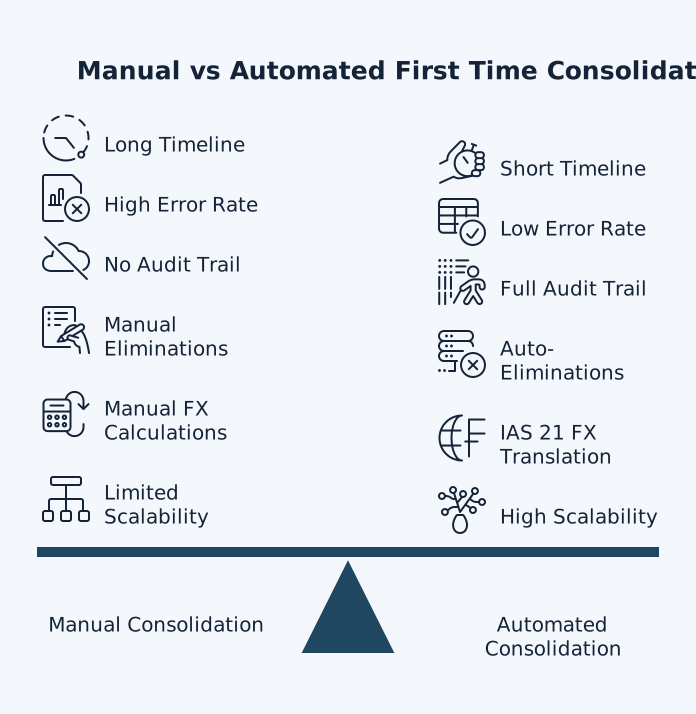
Manual first-time consolidation in spreadsheets is possible for a small group, but it introduces risk and consumes weeks of your finance team’s capacity. Automated consolidation software addresses the pain points directly.
dataSights connects multiple Xero entities into a single, automated consolidation workflow. The platform syncs data from each entity into a secure, dedicated per-customer SQL database. From there, you can generate consolidated reports through the dataSights web platform, Excel via automated add-ins, or Power BI for advanced analytics.
The specific benefits for first-time consolidators include:
Excel compatibility: 75% of dataSights customers work in Excel. The platform feeds automated data into your existing spreadsheet workflows, so your team keeps using familiar tools with better data.
For groups using Xero, this means your first consolidation can go from a multi-week manual exercise to a process that completes in days. dataSights clients consistently cut month-end close from over 15 days to under 5 days once the group consolidation process is set up.
What Happens After Your First Consolidation?
Your first consolidation sets the baseline for every period that follows. Here is what to expect going forward.
Ongoing monthly or quarterly consolidation: The process repeats each reporting period, but it gets faster. Your chart of accounts is standardised, intercompany rules are established, and your team knows the workflow.
Goodwill impairment testing: Goodwill recognised at acquisition must be tested for impairment annually under IAS 36. Track the carrying amount and be ready to recognise impairment losses if the subsidiary’s recoverable amount drops below its book value.
Evolving group structures: As you acquire or dispose of entities, your consolidation scope changes. Each new subsidiary triggers a mini first-time consolidation for that entity, while disposals require calculating a gain or loss on exit.
Audit readiness: Your auditor will want to see a clear trail from individual entity data through to the consolidated output. Maintain documentation of every elimination, adjustment, and policy alignment decision. Automated systems that maintain this audit trail from the start make your year-end audit process faster and less disruptive.
Streamline Your Multi-Entity Reporting With Automated Consolidation
Move from manual spreadsheets to automated consolidation. dataSights, rated 5.0 by 80+ verified Xero users, automates multi-entity P&L reporting across Excel, Power BI and web dashboards. Join 250+ businesses already running their finance data through one platform.
I'm Kevin Wiegand, and with over 25 years of experience in software development and financial data automation, I've honed my skills and knowledge in building enterprise-grade solutions for complex consolidation and reporting challenges. My journey includes developing custom solutions for data teams at Gazprom Marketing & Trading and E.ON, before founding dataSights in 2016. Today, dataSights helps over 250 businesses achieve 100% report automation.