Why Intercompany Reconciliation Matters for Your Group
Intercompany transactions take many forms across any multi-entity structure. Common types include:
- Sales and purchases between subsidiaries
- Management fee allocations
- Intercompany loans and related interest charges
- Dividends from subsidiaries to the parent
- Royalties and licence fees
- Cost recharges for shared services
Each of these creates pairs of entries that must net to zero at group level. Without proper reconciliation, these internal dealings inflate your consolidated financial statements and mislead stakeholders.
Regulatory Requirements Under IFRS and GAAP
Both major accounting frameworks mandate full elimination of intercompany activity. IFRS 10 requires that a parent eliminate all intra-group balances, transactions, income, and expenses when preparing consolidated financial statements. Under US GAAP, consolidation guidance follows the same principle, requiring all intercompany revenue, expenses, assets, and liabilities to be eliminated so that consolidated results reflect only external activity. See US GAAP consolidation principles overview.
If you operate under UK GAAP (FRS 102), Section 9 requires the same elimination approach. In Australia, AASB 10 adopts IFRS 10 directly, so the elimination requirements are identical for Australian groups reporting under Australian Accounting Standards. Regardless of whether your group reports under IFRS, US GAAP, UK GAAP, or Australian Accounting Standards, the goal is identical: present the group as a single economic entity.
The Real Cost of Getting It Wrong
Unreconciled intercompany transactions create audit findings, delay your close, and erode trust in your financial reporting. Benchmarking data from APQC shows the median monthly close takes 6.4 days. Additional research reported by CFO.com indicates that 50% of finance teams require six or more business days to close their books.
Every day your close drags out is a day your leadership team waits for reliable financial data. That delay compounds across monthly, quarterly, and annual reporting cycles. For Australian groups reporting to the ATO and ASIC, UK groups filing with Companies House, and US groups subject to SEC or state-level requirements, late or inaccurate intercompany data increases regulatory risk alongside operational cost.
The Intercompany Reconciliation Process Step by Step
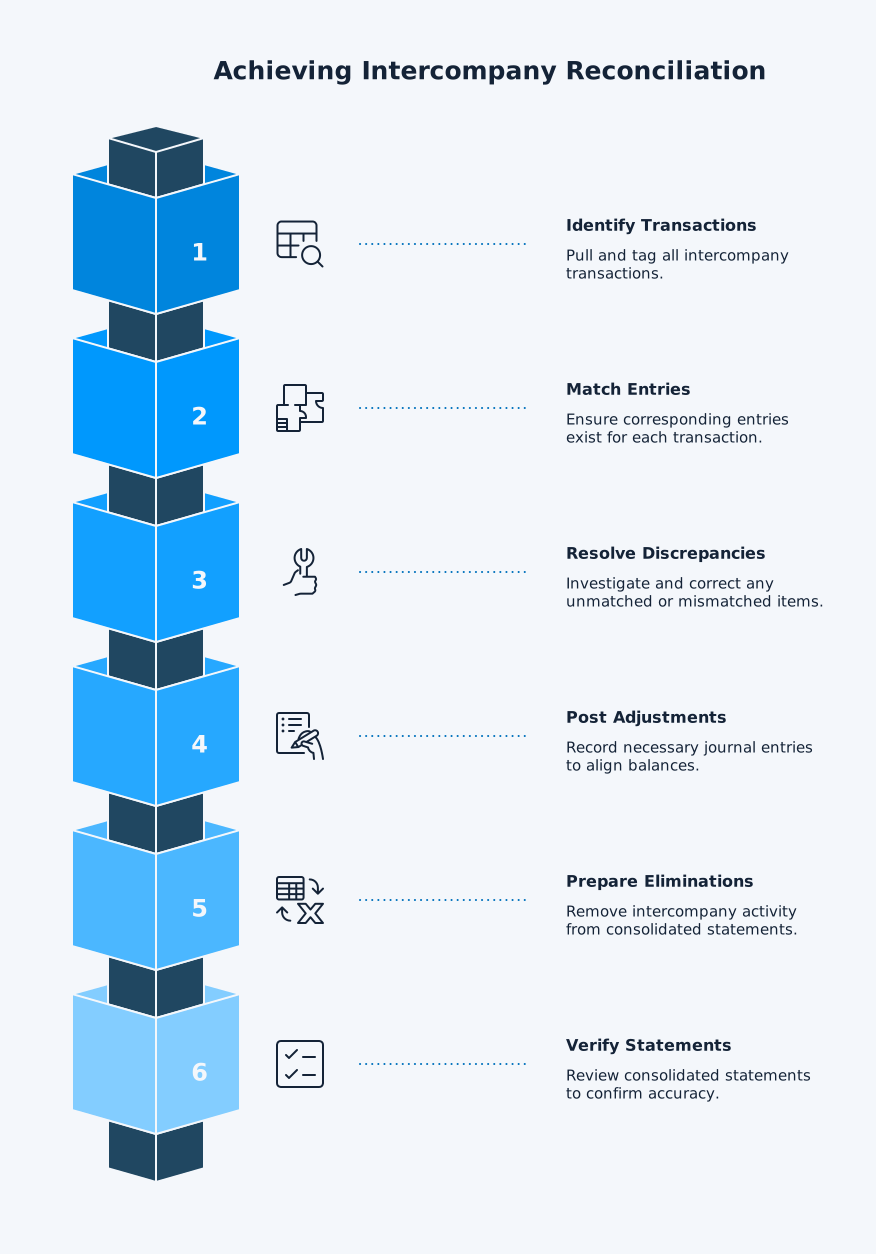
A structured approach reduces errors and shortens your close cycle. Here are the core steps in any intercompany reconciliation workflow.
Step 1: Identify All Intercompany Transactions
Start by pulling every transaction that involves a related entity. Tag each transaction with a standard intercompany identifier in your chart of accounts so you can filter them quickly at month-end. Transactions to capture include:
- Intercompany sales and purchases
- Loan advances and repayments
- Interest charges on intercompany financing
- Management fees and service recharges
- Dividend declarations
- Cost allocations and royalties
If your group operates multiple accounting systems or ledgers, each entity typically maintains its own general ledger. You need a consistent naming convention and account structure across all entities to make matching practical.
Step 2: Match Corresponding Entries
For every intercompany transaction recorded by Entity A, Entity B should have a mirror entry. Compare the following for each transaction pair:
- Transaction amount
- Currency and exchange rate applied
- Posting date and period
- Reference number or invoice ID
- Account classification
Entity A’s intercompany receivable should equal Entity B’s intercompany payable for the same transaction. This is where discrepancies surface. Common causes include timing differences, currency conversion variances, different descriptions, or missing entries.
Step 3: Investigate and Resolve Discrepancies
Work through each unmatched or mismatched item. Determine whether the root cause is a timing difference, data entry error, exchange rate variance, or a missing posting. Coordinate with the finance contacts at each entity to agree on corrections.
For multi-currency groups, exchange rate differences between booking dates add another layer. For intercompany balances denominated in foreign currencies, IAS 21 requires:
- Monetary items (e.g., intercompany receivables and payables): Translated at the closing rate at the reporting date
- Exchange differences: Recognised in profit or loss
- Timing differences between entities: May result in temporary reconciliation variances
These rate differences between entities often create reconciliation variances that finance teams must track separately.
Step 4: Post Adjusting Entries
Once you agree on the correct amounts, post adjusting journal entries to align both sides. Document each adjustment with the reason, the entities involved, and the supporting evidence.
Step 5: Prepare Elimination Entries
After balances match, prepare consolidation elimination entries to remove intercompany activity from your consolidated statements. Eliminations ensure your group financials show only transactions with external parties.
Step 6: Verify Consolidated Statements
Review the consolidated Trial Balance to confirm all intercompany balances have been properly eliminated. Cross-check that consolidated revenue, expenses, assets, and liabilities reflect only third-party activity. Your consolidated group reporting should tie back to entity-level Trial Balances at every step.
Common Intercompany Reconciliation Challenges
Multi-entity finance teams face predictable obstacles during intercompany reconciliation. Understanding them helps you build processes that prevent rather than fix problems.
1. Timing Differences Between Entities
Entity A records an intercompany sale on 31 March. Entity B does not post the corresponding purchase until 2 April. The result is a mismatch at month-end that needs investigation. Standardised cut-off procedures and aligned posting deadlines across entities reduce this issue.
2. Inconsistent Charts of Accounts
When subsidiaries use different account codes, descriptions, or classifications for the same type of transaction, matching becomes manual and slow. A standardised group consolidation process with unified account mapping eliminates this friction. Most finance teams implement a group chart-of-accounts mapping table that aligns subsidiary account codes with standardised group reporting categories.
3. Multi-Currency Complexity
Groups with entities in different countries deal with exchange rate variances on every intercompany transaction. An Australian parent lending AUD to a UK subsidiary, or a US entity purchasing services from a UK sister company in GBP, creates reconciliation differences whenever rates move. These variances are common across AU/GB/US group structures where three or more currencies interact. You need a clear policy on which rates to apply and when to post FX adjustments.
4. Spreadsheet Dependency
Despite well-documented spreadsheet error rates, new data from the Association for Financial Professionals suggests that legacy tools like Excel still dominate the FP&A function, even as adoption of newer technologies remains limited. Manual matching across copied-and-pasted data from multiple Xero organisations invites version control issues, broken formulas, and missed transactions.
5. High Transaction Volumes
As your group grows, intercompany transaction counts multiply. A group with ten entities can generate hundreds of intercompany transactions per month. Manual reconciliation at that scale becomes a bottleneck that extends your close by days.
Best Practices for Intercompany Reconciliation
Consistent processes significantly reduce reconciliation errors and prevent discrepancies from accumulating during the financial close. Finance teams that manage multi-entity groups typically implement standardised controls that make intercompany matching faster and easier to audit.
Common best practices include:
- Standardised entity codes: Assign a unique identifier to every legal entity in the group and include that code in all intercompany transactions to simplify matching.
- Matching reference IDs: Use the same invoice number, transaction reference, or journal ID across both sides of an intercompany entry to allow automated matching.
- Monthly reconciliation schedules: Reconcile intercompany balances as part of the monthly close rather than waiting until quarter-end or year-end, which reduces the number of unresolved discrepancies.
- Documented reconciliation ownership: Assign responsibility for each intercompany relationship to specific finance contacts at each entity so discrepancies can be investigated quickly.
Intercompany Elimination Entries Explained
Intercompany reconciliation feeds directly into the elimination process. Once intercompany balances match, you remove them from your consolidated statements so the group appears as a single economic entity.
Types of Intercompany Eliminations
The most common elimination categories include:
- Intercompany revenue and corresponding expenses
- Intercompany loans and associated interest income/expense
- Intercompany dividends
- Management fees and cost allocations
- Unrealised profit on intercompany inventory transfers
- Intercompany receivables and payables
Example: Intercompany Revenue and Expense Elimination
Entity A sells services to Entity B for $150,000 AUD. On consolidation, the $150,000 AUD intercompany revenue in Entity A and the corresponding $150,000 AUD intercompany expense in Entity B are eliminated. This removes only the intercompany portion. Any revenue from external customers remains in consolidated figures.
Example: Intercompany Loan Elimination
Parent lends £500,000 to Subsidiary at 5% interest annually.
The elimination entry removes both the loan balance and the associated interest:
- Dr Loan Payable (Subsidiary) £500,000 / Cr Loan Receivable (Parent) £500,000
- Dr Interest Income (Parent) £25,000 / Cr Interest Expense (Subsidiary) £25,000
These entries cancel the internal financial activity, leaving only genuine external economic transactions in your consolidated financial statements.
Unrealised Profit on Intercompany Inventory
Entity A sells inventory to Entity B for £50,000 (cost to Entity A: £40,000). Entity B has not resold the inventory by year-end. The £50,000 intercompany sale and the £10,000 unrealised profit are eliminated. Consolidated inventory shows at cost to the group (£40,000). External sales to customers outside the group are unaffected.
For a deeper look at elimination mechanics, see our guide to intercompany transactions in consolidated financial statements.
How to Automate Intercompany Reconciliation
Manual intercompany reconciliation does not scale. As your entity count grows, the combination of data extraction, matching, investigation, and elimination consumes days that your finance team cannot spare.
Moving Beyond Spreadsheets
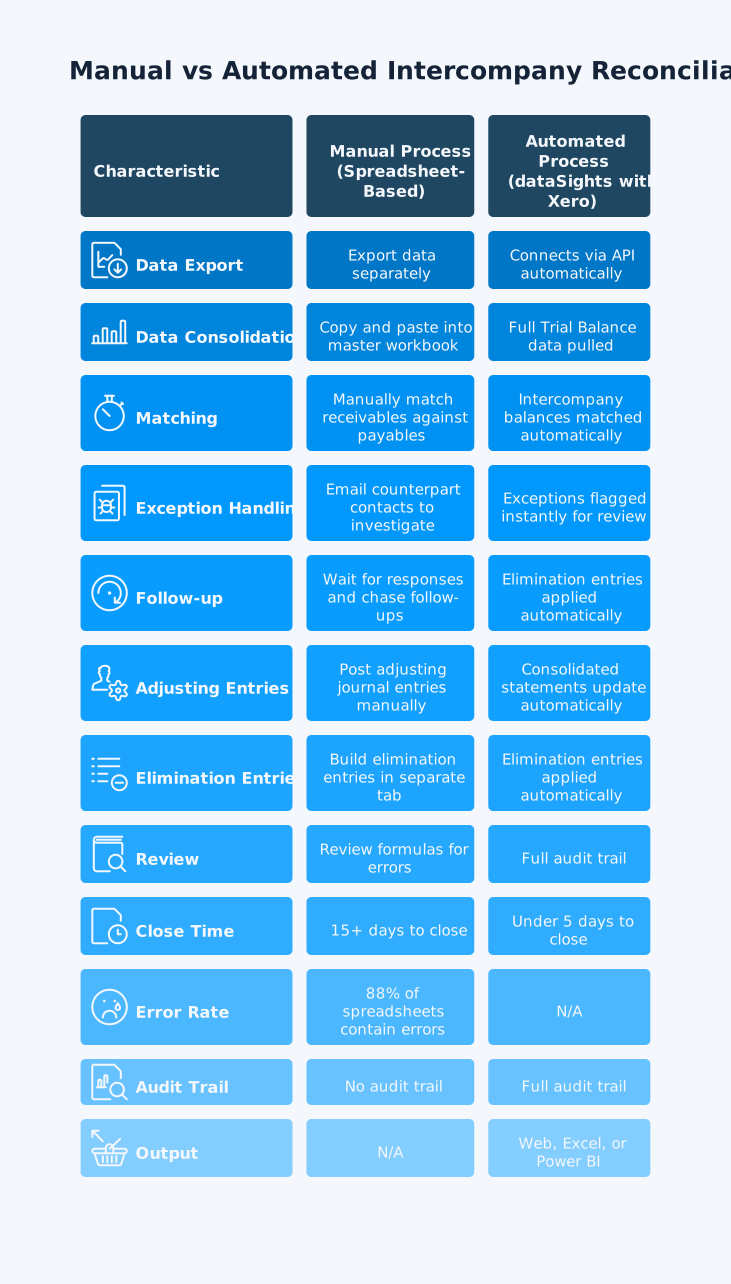
The shift from manual to automated intercompany reconciliation starts with a single source of truth. Instead of downloading separate reports from each Xero organisation and matching them in Excel, consolidation software pulls Trial Balance data from every entity into one place. Matching happens automatically against predefined rules, and exceptions surface immediately for your team to resolve.
Automation platforms typically use rule-based matching to compare transactions recorded in different entities and identify pairs that should reconcile. Matching logic usually evaluates several fields simultaneously, including:
- Counterparty entity codes to identify the related entity involved in the transaction
- Transaction amounts to confirm both sides recorded the same value
- Invoice numbers or reference IDs used by both entities
- Posting dates or accounting periods to detect timing differences
Transactions that do not meet the matching criteria are flagged as exceptions, allowing finance teams to investigate discrepancies before consolidation.
Modern financial consolidation platforms automate this process by connecting directly to accounting systems, identifying matching intercompany entries, and flagging discrepancies automatically. dataSights connects to each Xero organisation via API and stores data in a dedicated per-customer database. This gives your finance team a single view of intercompany balances across all entities, with differences flagged on a configured refresh schedule rather than discovered during a month-end scramble.
The Trial Balance as Your Reconciliation Foundation
Every accurate consolidation begins with the Trial Balance. dataSights pulls full Trial Balance data from each entity, ensuring that all intercompany reconciliations tie back to source systems. When an intercompany receivable in one entity does not match the corresponding payable in another, the discrepancy is visible immediately rather than buried in a spreadsheet tab.
Automated Elimination Processing
Once balances match, the platform automatically posts elimination entries using your configured rules. Auto-eliminations remove intercompany revenue, expenses, loans, and balances without manual journal entry work. Your financial consolidation process runs on a repeatable, auditable workflow rather than a manual checklist.
Outputs flow to your web platform, Excel via the OfficeAddIn and Power Query, or Power BI, whichever your team prefers. dataSights customers have reduced their month-end close from over 15 days to under 5 days across groups with both small and large numbers of entities.
Intercompany Reconciliation vs Financial Consolidation: What’s the Difference?
These two processes work together but serve different purposes. Reconciliation and consolidation are not the same. Intercompany reconciliation verifies that both sides of every internal transaction agree. Consolidation is the broader process of combining all entity-level financials into group statements, applying eliminations, and presenting the result.
Reconciliation is a prerequisite for consolidation. If intercompany balances do not match before you consolidate, your eliminations will be incomplete, and your consolidated statements will contain errors.