
Joint Venture Consolidated Financial Statements: A Practical Guide
by Kevin Wiegand
|May 11, 2026
|Xero
Your group owns 40% of an entity. You share control with two other partners. This catches finance teams out at month end. Joint venture consolidated financial statements do not follow the rules used for subsidiaries, and the equity method takes over instead. That single line item has its own rules for dividends, losses, and eliminations across IFRS, FRS 102, and US GAAP.
What Are Joint Venture Consolidated Financial Statements?
Joint venture consolidated financial statements show the investment as a single line item under the equity method. You record it at cost, then add your share of post-acquisition profits and OCI, and subtract dividends received. IFRS 11 and FRS 102 Section 15 generally require this approach, with limited exemptions under IAS 28, and proportionate consolidation has been off the table under IFRS since 2013.
Ready to Automate Your Financial Consolidation?
Stop wrestling with manual consolidations and broken formulas. dataSights automates multi-entity reporting, Xero consolidations, and Power BI connections. Join 250+ businesses already transforming their financial reporting with our platform, rated 5.0 out of 5 by 80+ verified Xero users.
Start Your Free 14-Day TrialTable of Contents
Applying the Equity Method in Joint Venture Consolidated Financial Statements
The equity method is the cornerstone of joint venture consolidated financial statements. You start with your initial investment cost, then adjust it each period for your share of the investee's profits or losses, and any dividends you receive. This method reflects your economic interest in the joint venture, rather than just the cash flows.
What Counts as a Joint Venture Under IFRS 11
A joint venture is a specific kind of joint arrangement. Two or more parties agree to share control, and they have rights to the net assets of the arrangement. The label sits inside IFRS 11 Joint Arrangements, which replaced IAS 31 and tightened the classification rules.
Joint Control: The Three Tests
For joint control to exist, all three of the following must be true:
- There is a contractual arrangement between the parties.
- That arrangement gives the parties joint control over the relevant activities.
- Decisions about those relevant activities need the unanimous consent of the controlling parties.
If any single party can decide alone, joint control does not exist. A simple majority threshold is not enough on its own, but it can still produce joint control if the contract specifies which combination of parties must agree. For example, if relevant decisions need 75% approval and three parties hold 50%, 30%, and 20%, the 50% and 30% parties together share joint control because they must both consent every time. The 20% party does not. The unanimity test applies to that controlling group, and it is the part teams most often misread.
What "Rights to Net Assets" Actually Means
Joint control alone does not make an arrangement a joint venture. Classification depends on whether your rights are to the net assets of the entity, or to the specific assets and obligations for liabilities. Rights to net assets means a joint venture, and you apply the equity method. Rights to specific assets and obligations for liabilities mean a joint operation, and you bring those items onto your accounts directly.
Joint Venture vs Joint Operation: A Decision Framework
The classification choice is not academic. It changes which numbers land on your group accounts. Use this short framework before you book anything.
Question 1: Is the arrangement structured through a separate legal entity?
If not, it is always a joint operation. Each party recognises its share of assets, liabilities, revenue, and expenses directly.
Question 2: If yes, what does the contract say about rights and obligations?
If the contract gives parties direct rights to the assets and direct obligations for the liabilities, it is a joint operation, regardless of legal form. If the contract gives parties rights only to the net assets, you have a joint venture.
Question 3: What do the other facts and circumstances show?
This step matters when the contract is silent. Look at how the arrangement is funded, who buys the output, and whether the parties' cash flows settle the venture's liabilities on a continuous basis. If the parties are the only source of cash flows that settle liabilities, the arrangement is usually a joint operation.
A common error is assuming that a separate legal entity automatically equals a joint venture. It does not. If your contract terms or operational facts give parties direct claims on assets and liabilities, you have a joint operation and you bring those line items onto your accounts. The label drives the accounting, not the legal wrapper.
The Equity Method on Group Accounts: Where the Numbers Land
The equity method is the required treatment for joint venture investments in your consolidated financial statements. Both IAS 28 and FRS 102 Section 15 require it, and ASC 323 mirrors the same model under US GAAP. The method tracks your economic interest in the joint venture rather than its underlying assets and liabilities.
Balance Sheet Presentation
Your investment in a joint venture appears as one line within non-current assets on the consolidated statement of financial position. Common labels are “Investment in joint venture” or “Equity method investment”. You do not bring the joint venture’s individual assets and liabilities onto your group balance sheet at all. The exception is when the investment, or part of it, meets the held-for-sale criteria under IFRS 5, in which case you stop applying the equity method and present the held-for-sale portion separately at the lower of carrying amount and fair value less costs to sell. The treatment differs from how subsidiary balances flow into consolidated financial statements.
Income Statement Presentation
Your share of the joint venture’s profit or loss appears as a single line in the consolidated income statement, usually after operating profit and before tax. Older UK GAAP under FRS 9 used a “gross equity method” that showed your share of turnover and operating profit on the face of the accounts. Current standards drop that. Only the net share of profit shows on the face.
Cash Flow Statement
Under current IAS 7, dividends received from a joint venture can be classified as either operating or investing cash flows, provided you apply the chosen policy consistently. Most groups present them in investing activities to match the equity method’s economic logic, but operating is permitted. From annual periods beginning on or after 1 January 2027, IFRS 18 reshapes the classification rules, so check your group’s accounting policy each year as the transition date approaches. Whichever line you use, the cash receipt does not equal the underlying revenue from the joint venture.
Step-by-Step Equity Method Workflow
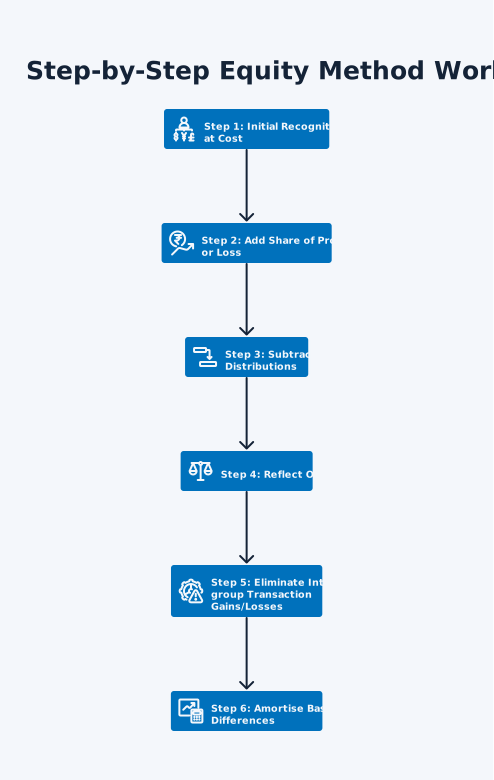
The equity method runs on a few simple rules, applied in order each period. The six steps below cover initial recognition through ongoing adjustments.
Step 1: Initial recognition at cost.
Record the investment at cost on acquisition. Cost includes the purchase price, transaction costs directly attributable to the deal, and any contingent consideration measured at fair value. At the same time, identify any basis differences, which are gaps between your cost and your share of the fair value of the joint venture's identifiable net assets.
Step 2: Add your share of profit or loss.
After acquisition, adjust the investment for your percentage share of the joint venture's profit or loss each period. If you hold 40% and the joint venture posts a £500,000 profit, you book £200,000 as your share. The same £200,000 increases your investment balance and shows on your income statement as "Share of profit of joint venture".
Step 3: Subtract distributions.
When the joint venture pays a dividend, the cash receipt reduces your investment balance. Distributions are not income. You have already taken your share of the underlying profit in Step 2, so booking the dividend as income would double-count.
Worked example: You hold 50% of JV Limited, which reports a £200,000 profit and pays £80,000 in dividends. You recognise £100,000 as share of profit and increase the investment by £100,000. You then receive £40,000 in cash and reduce the investment by £40,000. Net movement is a £60,000 increase in the carrying amount.
Step 4: Reflect OCI.
If the joint venture posts items through other comprehensive income, such as revaluation gains or foreign currency translation differences, take your share through your own OCI. This keeps your investment balance aligned with your share of the joint venture's equity.
Step 5: Eliminate gains and losses on intra-group transactions.
When your group sells goods or services to the joint venture, or vice versa, recognise the unrealised gain or loss only to the extent of unrelated investors' interests, which means you eliminate your own share. The details of this rule sit in the next section, because it is the part finance teams most often get wrong.
Step 6: Amortise basis differences.
If you paid more than your share of the fair value of identifiable net assets, allocate the premium to underlying assets where possible (undervalued tangibles, unrecognised intangibles), and amortise that allocation over the assets’ useful lives. Any residual goodwill is not amortised under IFRS and is not recognised separately, because it sits inside the carrying amount of the equity-accounted investment. When indicators of impairment arise, you test the whole investment as a single asset by comparing its carrying amount to its recoverable amount under IAS 36.
Eliminating Gains and Losses on Transactions With Your Joint Venture
Eliminations between groups and joint ventures trip up close packs every quarter. The rules are narrower than most people remember.
Under IAS 28.28, gains and losses from upstream and downstream transactions are recognised only to the extent of unrelated investors' interests. The investor eliminates its own share. If your group holds 40% of the joint venture, you eliminate 40% of the unrealised gain or loss, and the remaining 60% stays in profit because that share belongs to the unrelated investors.
This is different from full subsidiary consolidation. Under IFRS 10, you eliminate intra-group transactions and balances in full, because the subsidiary is part of the group. A joint venture is not part of the group, so the intercompany reconciliation and elimination entries you book for subsidiaries do not apply in the same way.
Worked Downstream Example
Your subsidiary sells inventory to JV Limited for £100,000. The subsidiary's cost is £60,000, leaving an unrealised profit of £40,000. You hold 40% of JV Limited, and at year end, JV Limited still holds the inventory. You eliminate your 40% share of the unrealised profit, which is £16,000. That £16,000 reduces both your reported profit and your investment in the joint venture. The other £24,000 stays in profit because it belongs to the unrelated 60% of the joint venture.
Worked Upstream Example
JV Limited sells goods to your subsidiary for £100,000. The joint venture's cost is £60,000, so the unrealised profit at the joint venture is £40,000. You hold 40% of JV Limited, and your group still holds the inventory at year end. You eliminate your 40% share, which is £16,000, against your share of the joint venture's profit. Your reported share of profit drops by £16,000, and the other £24,000 of unrealised profit stays in the joint venture's books because it belongs to the unrelated investors.
A common practitioner approach also eliminates the full intercompany revenue and receivables through the consolidation worksheet. That is broader than the standard requires, and the IASB's 2024 exposure draft on the equity method proposes to remove the elimination requirement for upstream and downstream gains and losses entirely. Until the amendments are finalised, apply IAS 28.28 as written.
When Joint Venture Losses Exceed Your Investment
The equity method has a floor. Once your investment balance hits zero through cumulative losses, you stop recognising further losses. The exception is when you have legal or constructive obligations to fund the joint venture, or you have already made payments on its behalf.
If you have other long-term interests in the joint venture, such as unsecured loans, apply losses against those interests in reverse order of seniority. The most junior interests absorb losses first.
When the joint venture returns to profitability, you do not resume the equity method until your share of cumulative unrecognised losses has been recovered.
Worked example:
Your investment in JV Limited has a carrying value of £150,000. You also hold a £100,000 unsecured, subordinated loan receivable from JV Limited. Your share of JV Limited's losses for the year is £200,000.
| Application | Amount |
|---|---|
| Loss against investment balance | £150,000 (reduces investment to nil) |
| Loss against a subordinated loan | £50,000 (reduces loan to £50,000) |
| Unrecognised loss | £0 |
In the next year, if your share of JV Limited's profit is £30,000, you apply that profit against the loan first to restore it back towards £100,000, before the investment balance starts moving again.
Framework Comparison: IFRS, FRS 102, and US GAAP
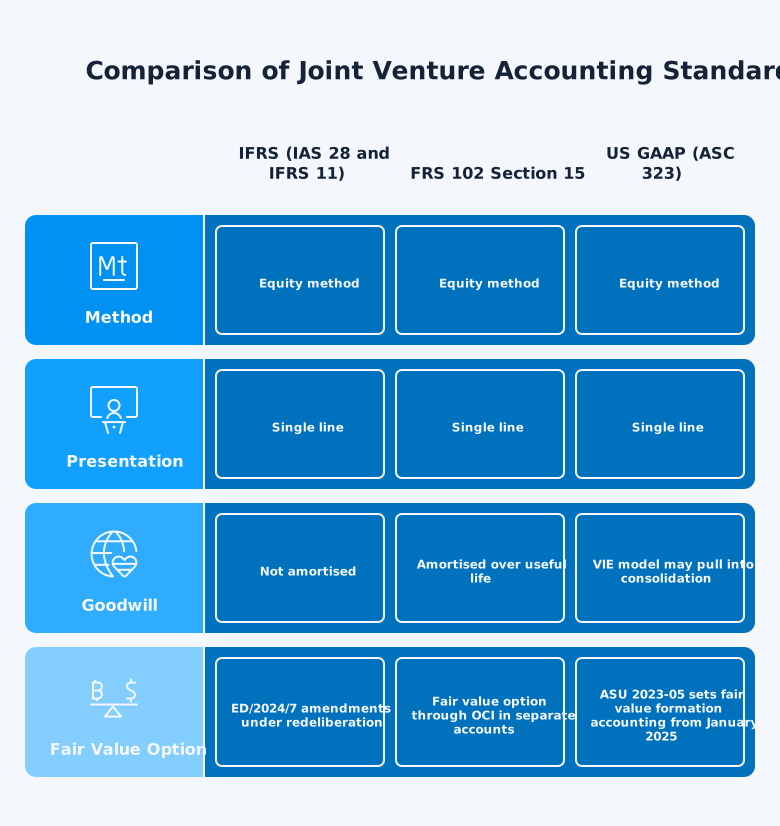
Most large UK groups apply UK-adopted IFRS, but smaller groups and some private companies use FRS 102. Cross-border groups also need to track US GAAP. The mechanics are similar, but the wrapper around them differs.
| Aspect | IFRS (IAS 28 and IFRS 11) | FRS 102 Section 15 | US GAAP (ASC 323) |
|---|---|---|---|
| Terminology | Joint venture | Joint venture (with three sub-types: jointly controlled operations, jointly controlled assets, jointly controlled entities) | Joint venture |
| Method in consolidated accounts | Equity method only | Equity method only | Equity method, with VIE caveat |
| Single-line presentation | Yes | Yes | Yes |
| Loss recognition floor | Stop at nil unless legal or constructive obligation | Stop at nil unless legal or constructive obligation | Stop at nil; specific rules for guarantees |
| Goodwill on investment | Not amortised; impairment tested under IAS 36 | Amortised over useful life | Not amortised; impairment tested |
| Reporting date difference | Up to three months, with adjustments | Up to three months, with adjustments | Up to three months |
| Recent or proposed updates | IASB ED/2024/7 (under redeliberation) | Periodic Review 2024: effective from periods beginning 1 January 2026, early application permitted | ASU 2023-05 on JV formation, effective 2025 |
IFRS Specifics
IFRS 11 and IAS 28 set the rules. IFRS 11 splits joint arrangements into joint operations and joint ventures. IAS 28 applies the equity method to both joint ventures and associates. The IASB's equity method project is currently redeliberating proposals from Exposure Draft ED/2024/7. The amendments are not yet final, so apply the current standard as written.
FRS 102 Specifics
FRS 102 Section 15 uses 'joint venture' as the umbrella term, with three sub-types: jointly controlled operations, jointly controlled assets, and jointly controlled entities. The first two map to joint operations under IFRS 11, while jointly controlled entities sit closest to the IFRS 11 joint venture concept and use the equity method in consolidated accounts. Two material differences from IFRS:
- FRS 102 amortises goodwill over its useful life, while IFRS does not.
- The measurement options in individual or separate financial statements are different. FRS 102 lets you choose cost, fair value through OCI, or fair value through profit or loss. IAS 27 lets you choose cost, IFRS 9 measurement (typically fair value through profit or loss), or the equity method.
US GAAP Specifics
ASC 323 sets out the equity method for US GAAP. The Variable Interest Entity model under ASC 810 can pull a joint venture into full consolidation in circumstances where IFRS would still apply the equity method, particularly where one party absorbs most of the variability. ASU 2023-05, effective for joint ventures formed on or after 1 January 2025, also requires the joint venture itself to measure its initial net assets at fair value on formation. That is a change in the joint venture's books, not the investor's, but it can affect the basis differences you recognise on day one.
Disclosure Requirements Under IFRS 12
Disclosure for joint ventures sits in IFRS 12 Disclosure of Interests in Other Entities under IFRS, and in the FRS 102 Section 15 disclosure requirements under UK GAAP. The level of detail tracks how material the joint venture is to your group.
Required disclosures fall into four buckets:
- 1. Nature and extent of interests: Name of each material joint venture, principal place of business, ownership percentage, and a description of the relationship.
- 2. Summarised financial information for material joint ventures: Current and non-current assets, current and non-current liabilities, revenue, profit or loss from continuing operations, OCI, and total comprehensive income.
- 3. Reconciliation of carrying amount: Opening balance, share of profit or loss, share of OCI, dividends received, and closing balance.
- 4. Other: Any unrecognised share of losses, contingent liabilities relating to joint ventures, and commitments such as funding obligations.
Common Joint Venture Accounting Mistakes (and How to Avoid Them)
Five mistakes show up in close packs more than any others. Each is fixable once you know what to look for.
Mistake 1: Treating Dividends As Income
The cash receipt from a joint venture is not income under the equity method. It reduces the investment balance. Coding the dividend to income double-counts the underlying profit you have already picked up.
Mistake 2: Eliminating Intra-group Transactions in Full
Joint ventures are not part of the group under IFRS 10, so the full elimination rule for subsidiaries does not apply. Eliminate your own share of unrealised gains and losses on upstream and downstream transactions, not the full amount. The unrelated investors' share stays recognised under IAS 28.28.
Mistake 3: Classifying Based on Legal Form Alone
A separate legal entity does not automatically make an arrangement a joint venture. If the contract or other facts give parties direct rights to assets and obligations for liabilities, the arrangement is a joint operation, and you bring those items onto your accounts directly.
Mistake 4: Forgetting Basis Differences
When you pay more than your share of the fair value of identifiable net assets, allocate the premium and amortise the parts that relate to depreciable or amortisable assets. Many close packs treat the investment balance as static, which understates expense and overstates the carrying amount over time.
Mistake 5: Recognising Losses Past Zero With No Obligation
If your investment hits zero, stop recognising your share of losses. The only exceptions are a legal or constructive obligation, payments already made on behalf of the joint venture, or other long-term interests that absorb losses next.
Automating Equity Pickup and Joint Venture Reporting
Joint venture accounting compounds the manual work of group close. You wait for the joint venture to send you their numbers, you reconcile reporting dates, you recompute equity pickups, and you manage two parallel sets of policies if the joint venture's policies differ from your group's.
dataSights handles the parts of joint venture consolidation that are repetitive each period:
- Trial balance data from each entity flows in through Xero connections or scheduled refreshes from external source data, so the equity pickup journal you book each period sits on consistent, current numbers rather than spreadsheets you rebuild manually.
- Manual journal adjustments at the consolidation layer let you record the equity-method entries (share of profit, dividends received, OCI movements, basis difference amortisation) once, and have them flow through to your management pack without re-keying.
- Audit trails on every consolidation entry give you the line-by-line evidence auditors ask for.
For groups already running Xero across their wholly-owned subsidiaries, dataSights connects directly to Xero and pulls the underlying transaction data. Joint venture data that sits outside Xero comes in via the OfficeAddIn, Power Query, or the financial consolidation process, and lands in the same management pack alongside subsidiary results. For Xero consolidation workflows specifically, you keep one source of truth for elimination entries and equity pickups across periods. Power BI integration on top of that gives finance teams interactive dashboards showing joint venture performance next to group results, with drill-through to the underlying records.
The trade-off versus a spreadsheet workflow is set-up time. Spreadsheets are flexible day one but require manual rebuilding each period. Automated consolidation needs upfront configuration of entity mappings, intercompany rules, and consolidation entries, after which the same workflow runs each close. Teams we work with often see month-end consolidation move from weeks down to days once the configuration is in place.
Frequently asked question
Both joint ventures and associates use the equity method in consolidated financial statements, but the relationship differs. A joint venture requires joint control, where decisions need unanimous consent of the controlling parties. An associate requires significant influence, often presumed at 20% or more ownership, but not control or joint control. The accounting mechanics are essentially the same.
No. IFRS 11, effective from 2013, removed proportionate consolidation for joint ventures. The equity method is the only treatment for joint ventures in consolidated accounts. Joint operations are different. You recognise your share of specific assets, liabilities, revenue, and expenses directly, but that is not the same as proportionate consolidation.
In separate (unconsolidated) financial statements, IFRS allows three options: cost, IFRS 9 measurement, or the equity method. FRS 102 allows cost, fair value through OCI, or fair value through profit or loss. The choice must apply consistently within each category of investment.
If you lose joint control but keep significant influence, the investment becomes an associate and continues under the equity method. If you lose both, derecognise the investment, measure any retained interest at fair value, and recognise the gain or loss in profit or loss. The gain or loss equals the fair value of the retained interest plus any proceeds from the disposal, less the carrying amount of the investment at the date joint control was lost.
Eliminate your own share of unrealised gains and losses on upstream and downstream transactions, per IAS 28.28. The unrelated investors’ share stays recognised. Do not eliminate the full intercompany transaction in the way you would for a subsidiary, because the joint venture is not part of the group under IFRS 10.
The core approach is the same. Both require the equity method for jointly controlled entities and joint ventures in consolidated accounts. Differences sit in goodwill amortisation (allowed under FRS 102, not under IFRS), the options available in separate financial statements, and terminology. FRS 102 uses ‘joint venture’ as the umbrella term and applies the equity method specifically to jointly controlled entities, the sub-type that maps closest to an IFRS 11 joint venture.
Disclose the name and principal place of business of each material joint venture, the ownership percentage, summarised financial information, a reconciliation of the carrying amount, any unrecognised share of losses, contingent liabilities, and commitments. The level of detail scales with materiality. Smaller joint ventures may be disclosed in aggregate.
IAS 28 and FRS 102 both allow up to a three-month gap between the joint venture’s reporting date and your group’s, but only when alignment is impracticable. You must adjust for significant transactions and events in the intervening period, and document the basis of those adjustments for audit.
Both IAS 7 and FRS 102 permit either operating or investing classification, applied consistently. Most groups choose investing because it aligns with the equity method’s economic logic, but operating remains a valid policy choice. IFRS 18, effective from annual periods beginning on or after 1 January 2027, will change the rules, so review your policy ahead of the transition date.
Bringing Clarity to Joint Venture Consolidation
Joint venture accounting does not need to slow your close. Get the classification right, apply the equity method in order, and limit eliminations to the standard’s actual scope. With the rules in place, your team can spend the close window analysing performance rather than chasing reconciling items.
Closing the Loop on Inventory and Accounting
Xero inventory management on its own only takes a product business so far before the 4,000 tracked item limit, the weighted-average-cost-only valuation and the single-location limitation start showing up in month-end. Cin7 Core fills the operational inventory gap, but the consolidated reporting gap across Cin7 Core, multiple Xero entities and other systems still exists. Finance teams that move past CSV exports and into a unified Cin7 Core and Xero data hub get back the days they used to lose to manual consolidations and gain a defensible group view of inventory, COGS and gross margin. To see how that works end-to-end, the Xero consolidation services page walks through the full reporting model.
Transform Your Joint Venture Consolidation With Automated Reporting
Stop spending close week recalculating equity pickups and chasing joint venture data. dataSights automates the consolidation pieces around your equity-method entries: trial balance ingestion from Xero, intercompany eliminations, manual journal adjustments, and audit-ready outputs. Rated 5.0 out of 5 by 80+ verified Xero users and trusted by 250+ businesses worldwide the platform helps finance teams move month-end consolidation from weeks down to days.
Start Your Free 14-Day Trial
Kevin Wiegand
Founder & Client happiness
I'm Kevin Wiegand, and with over 25 years of experience in software development and financial data automation, I've honed my skills and knowledge in building enterprise-grade solutions for complex consolidation and reporting challenges. My journey includes developing custom solutions for data teams at Gazprom Marketing & Trading and E.ON, before founding dataSights in 2016. Today, dataSights helps over 250 businesses achieve 100% report automation. I'm passionate about sharing my expertise to help CFOs and Financial Controllers reduce their month-end close time and eliminate the manual Excel exports that drain their teams' valuable time.